How to Dilute Silicone Defoamer: Step-by-Step Guide
Direct Answer
Dilute a silicone defoamer only when the supplier confirms that the grade is dilution-stable. Use clean water of suitable hardness and temperature, add the defoamer slowly into the water under gentle agitation, and avoid high shear that can damage the emulsion. Prepare only the amount that can be used promptly because a diluted product has lower storage and microbial stability. Before plant use, check homogeneity, separation, viscosity and foam-control performance against the undiluted product, and base the final use dose on active material rather than diluted volume.
Can Silicone Defoamer Be Diluted With Water?
Yes for some grades, but not for every silicone defoamer. Product type and intended storage time determine the correct method. A ready-to-dilute emulsion may accept water with gentle mixing, while another grade may be best used as supplied. A stored low-active dilution may need a supplier-approved thickened water phase and preservation system.
| Product instruction | Recommended action | Validation before plant use |
|---|---|---|
| TDS says ready to dilute | Use the listed water quality and ratio; add product slowly under the specified agitation. | Check homogeneity, separation, viscosity and foam control. |
| Diluted stock must be stored | Ask whether a thickened water diluent and compatible preservative are required. | Run accelerated and real-time stability checks for the intended storage period. |
| TDS says ready to use or gives no dilution method | Dose as supplied or obtain a written, grade-specific procedure. | Do not extrapolate a ratio from another product. |
| Concentrate intended for formulation | Treat dilution as an emulsion-formulation project using the complete supplier formula. | Verify pH, viscosity, droplet stability, preservation and active-content performance. |
Ratio calculator: only when a TDS permits a simple product-to-water ratio of 1:n, product mass = final batch mass ÷ (1+n). This shortcut does not apply to stabilized formulas that also contain thickener, neutralizer or preservative.
Technical source examples: Momentive SAG 10/10E TDS, Momentive SAG 290 TDS, and WACKER SILFOAM SE 2660 TDS. These examples show why dilution instructions must remain grade-specific.
Last updated: August 2026
Prerequisites and Grade-Specific Procedure
Obtain the current technical data sheet and a dilution procedure for the exact silicone defoamer grade. It should identify water quality, every component, final batch mass, addition sequence, mixing conditions and required quality checks.
- Use a clean mixing vessel and suitable measuring equipment.
- Set mixing speed, temperature and pH according to the validated procedure; a single RPM or pH range does not apply to every product.
- Account for all additives in the final batch mass. Do not add preservatives or pH-adjusting chemicals without an approved formulation.
Review the available silicone defoamer grades and request instructions for the selected product.
Scope: Follow the procedure for the exact grade. Do not transfer a dilution formula or storage claim from another product.
Only when the product technical data sheet confirms water dilution and specifies the method. Some silicone antifoam emulsions are dilution-stable; others are best used as supplied. Dilutions intended for storage may require a thickened water phase and a compatible preservation system. Always run a small stability and foam-control trial before plant use.
Confirm the Product Grade Before Mixing
Exact silicone defoamer grade and active content: Confirm the product TDS; do not substitute a 20% or 30% assumption from another grade.
Approved diluent and water quality: Use only the diluent specified for that grade.
Stabilizer or thickener: Required only when the grade-specific procedure or intended storage stability calls for it.
Preservative and pH adjustment: Select for compatibility and local regulatory requirements; follow supplier and label directions.
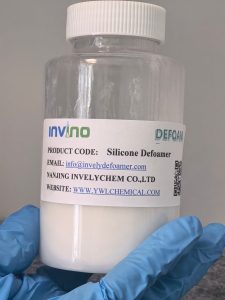
⚠️ Important: Can I add water directly? Only if the grade-specific TDS confirms water dilution. Some emulsions are dilution-stable, while others should be used as supplied; a stored dilution may require a supplier-approved thickened water phase. Validate a small batch before plant use.
Three Steps to Validate a Grade-Specific Dilution
Step 1: Confirm the Procedure
Confirm the exact product grade, approved water quality and complete supplier procedure. Identify the final batch mass and include all additives in that total.
Step 2: Prepare a Trial Batch
Prepare a small trial batch using the specified addition sequence, mixing conditions and temperature. Do not substitute another grade or extrapolate a ratio.
Step 3: Verify Performance
Check homogeneity, separation, viscosity and foam-control performance. Use only the preservation strategy and holding time validated for this dilution.
Use the current procedure for the selected grade. Do not transfer quantities or storage claims from another product.
Handling notes
- Use the mixing conditions, water quality and holding time validated for the selected grade.
- Check separation, viscosity and foam-control performance before plant use.
- Prepare only the amount needed within the validated holding time.
- Use any preservation or pH-adjustment system only as specified by the supplier, including applicable label directions.
Quality Control & Handling Notes
- Visual inspection: Check the trial batch against the appearance and homogeneity criteria in the grade-specific procedure.
- Preventing contamination: Use suitable water, clean equipment and the supplier-approved preservation strategy for the intended holding time.
- Changes during holding: If separation, oiling or unexpected viscosity changes occur, stop and investigate the formulation and preparation conditions before use.