
Mineral Oil Defoamer & Oil-Based Antifoam Supplier | INVINO®
For Waterborne Paints, Adhesives, Printing Inks and Latex Systems
INVINO® mineral oil defoamers are non-silicone, 100% active hydrocarbon compound antifoaming agents for foam control in waterborne architectural paints and industrial coatings, latex-based adhesives, emulsion polymer systems, and water-based printing inks. Because they contain no silicone oil, mineral-oil grades can reduce silicone-contamination risk in coating and adhesive formulations. Final film compatibility—including cratering, fish-eyes, gloss and inter-coat adhesion—remains formulation- and dose-dependent and must be confirmed by drawdown testing.
In waterborne coating production, foam is generated during high-shear grinding — and if not controlled, it transfers to the applied film as pinholes, craters, and uneven gloss. INVINO mineral oil defoamers are intended for foam control during grinding and/or let-down, depending on the grade and formulation. The listed grades are supplied at 100% active content. Dosage, binder compatibility, gloss impact and any APEO/VOC statement must be confirmed for the named grade using its current TDS/SDS, applicable test report and a formulation trial.
Request Sample & Technical Guidance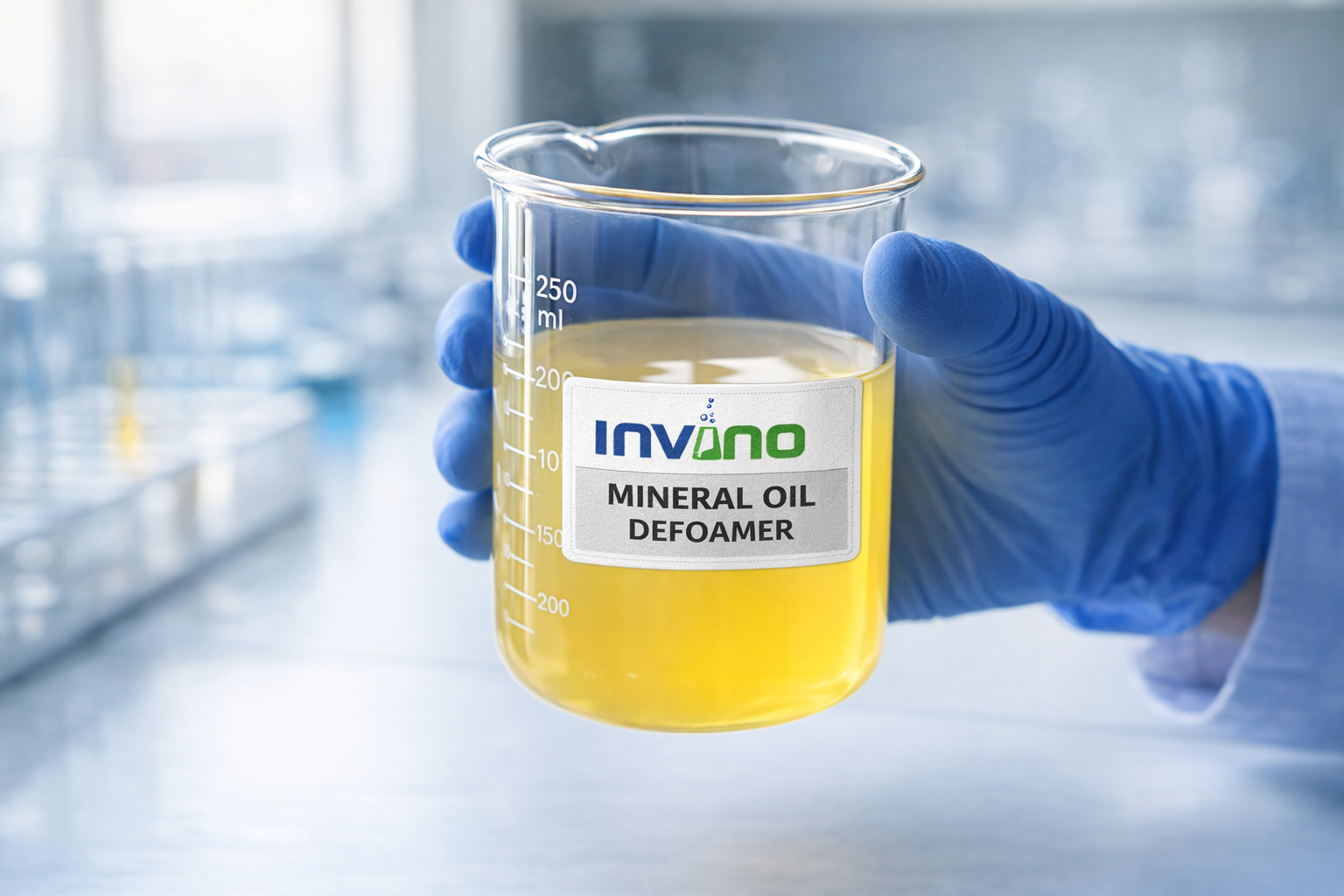
Mineral Oil Defoamer Composition & Selection
A mineral-oil defoamer is a formulated oil-based antifoaming additive—not simply neat mineral oil. Commercial products commonly combine a mineral-oil carrier with one or more hydrophobic or surface-active components; the exact composition is grade-specific.
1. Match the coating system
Record binder chemistry, pigment volume concentration, solids, pH, rheology modifier, gloss target and whether silicone is restricted.
2. Choose the addition stage
Screen grind, let-down and split addition. Incorporation shear and post-add compatibility can change both foam control and film appearance.
3. Find the lowest effective dose
Compare an untreated control with stepped doses. Measure macrofoam, microfoam, density, gloss, cratering, color acceptance and recoatability.
4. Verify documents and scale-up
Confirm the current TDS/SDS and any grade-specific regulatory report, then repeat the selected dose in a pilot batch before production release.
Mineral Oil Defoamer Formulation Specifications
Four grades covering different waterborne binder systems. All grades are 100% active content — no water carrier. Select the grade matched to your resin system and application requirements.
| Product Grade | Appearance | Active Content | pH | Viscosity (cps) | Compatible Systems & Key Characteristics |
|---|---|---|---|---|---|
| INVINO-3000 | Grey opaque viscous liquid | 100% | 5.5–7.0 | 500–1000 | General-purpose grade for waterborne architectural paints: styrene-acrylic, silicone-acrylic, pure acrylic, and vinyl acetate binder systems. Interior and exterior wall coatings. Controls grinding foam and prevents film cratering. |
| INVINO-3001 | Grey opaque viscous liquid | 100% | 5.5–7.0 | 500–1000 | Waterborne architectural coatings with higher styrene-acrylic or silicone-acrylic content. Optimized for systems with stricter film appearance requirements and surface defect tolerance. |
| INVINO-3200 | Yellow to amber fluid liquid | 100% | 5.5–7.0 | 500–1000 | Emulsion-type polymer adhesives, latex paint bases, and pressure-sensitive adhesives. Fast foam knockdown during mixing without affecting bond strength or peel adhesion. |
| INVINO-3100 | Yellow to amber fluid liquid | 100% | 5.5–7.0 | 500–1000 | Waterborne printing inks and high-gloss interior latex paints. Low-viscosity grade with minimal impact on film clarity and gloss — recommended when transparency is critical. |
Key Application Areas for Mineral Oil Defoamers
INVINO mineral oil defoamers are specifically engineered for waterborne systems where silicone contamination is unacceptable.
Paints & Architectural Coatings
Controls foam generated during high-shear grinding of acrylic, styrene-acrylic, and silicone-acrylic latex systems. Prevents cratering, fish-eyes, and pinhole defects in the applied film without silicone contamination risk.
Explore Coatings Solutions →
Adhesives & Sealants
INVINO-3200 for emulsion-type polymer adhesives and pressure-sensitive adhesive compounding. Fast foam knockdown during high-shear mixing without affecting bond strength, peel adhesion, or tack properties.
Explore Adhesives Solutions →
Emulsion Polymers & Latex
Effective foam control in SBR latex, acrylic emulsion polymerization, and vinyl acetate copolymer systems. Eliminates entrained air during mixing without interfering with polymer particle stability or coagulation.
Explore Polymer Solutions →Why Choose Mineral Oil Defoamer Over Silicone Alternatives?
For waterborne coating and adhesive formulations, mineral oil defoamers deliver specific performance advantages over dimethyl silicone emulsions — particularly where film surface quality, inter-coat adhesion, and environmental compliance are critical requirements:
- No Cratering, Fish-Eyes, or Silicone Oil Contamination — Mineral oil compounds contain no silicone. They collapse foam without depositing silicone residues on the coating film — eliminating the cratering, fish-eye, and inter-coat adhesion failures that commonly occur when silicone defoamers are used in acrylic latex systems and multi-layer coating applications.
- Broad Binder System Compatibility — INVINO mineral oil defoamers are compatible with styrene-acrylic, pure acrylic, silicone-acrylic, and vinyl acetate emulsion systems without causing viscosity drift, chemical coagulation, or emulsion destabilization during grinding or let-down stages.
- 100% Active Content — Cost-Effective Dosing — 100% active content (no water carrier) means higher defoaming efficiency per unit weight. Effective foam control at 0.1%–0.3% w/w in paint grinding, reducing raw material cost compared to diluted silicone emulsion alternatives.
- Foam Control Without Affecting Recoatability — Mineral oil compounds collapse entrained foam during high-shear grinding and packaging without leaving hydrophobic residues that would prevent secondary coat adhesion — a critical requirement for multi-layer architectural and protective coating systems.
Summary: Mineral oil defoamers are the standard non-silicone antifoaming solution for waterborne architectural coatings, adhesives, and printing inks where film appearance quality and recoatability are critical. They prevent cratering and silicone contamination while maintaining compatibility with acrylic and vinyl acetate binder systems.
Documentation & Grade-Specific Compliance Review
Confirm the Named Grade, Test Scope, Date and Destination Market
ISO 9001 certification addresses the quality-management system; it does not by itself prove every product- or end-use claim. APEO, VOC, SVHC, heavy-metal, PAH and phthalate statements are grade-, method-, threshold- and market-specific. Request the current document package before approval.
- Quality system: verify the current ISO certificate and certificate scope.
- Composition and restricted substances: review the named grade's TDS/SDS and the relevant analytical report.
- VOC or ecolabel use: compare the stated method and threshold with the destination-market requirement.
- Heavy metals, PAHs, SVHCs and phthalates: confirm analyte list, reporting limit, sample identity and report date.
- End use: food contact, children's products and other regulated claims require application-specific legal and customer review.
Frequently Asked Questions — Mineral Oil Defoamer for Waterborne Coatings & Adhesives
Q. What causes cratering and fish-eyes in waterborne coatings, and how does mineral oil defoamer prevent them?
Cratering and fish-eyes can arise from entrained air, wetting problems, contamination or surface-tension imbalance. A silicone-free mineral-oil defoamer may reduce one contamination route, but performance depends on binder, pigment volume concentration, addition stage and dose. Confirm with foam, drawdown, gloss and recoat tests.
Q. Why does mineral oil defoamer separate or stratify during storage?
Phase separation of hydrophobic active particles within the mineral oil carrier is a normal physical characteristic of 100% active-content compounds — it does not indicate product degradation. Low-shear mechanical agitation before use fully restores uniform consistency and defoaming performance. Store at 5–35°C and avoid freezing.
Q. Is mineral oil defoamer suitable for high-gloss paints?
Mineral oil defoamers can reduce film clarity in high-gloss topcoats if overdosed. For high-gloss applications, use INVINO-3100 — the low-viscosity grade specifically formulated to minimize gloss impact while maintaining foam control. Always start at the lower end of the dosage range (0.05%–0.1% w/w) and run drawdown test strips before full production addition.
Q. Does INVINO mineral oil defoamer contain APEO or VOCs?
Documentation is grade- and market-specific. Review the current TDS/SDS and the applicable APEO or VOC test report for the named grade, including method, threshold and report date, before making an ecolabel, low-VOC or indoor-air claim.
Q. Mineral oil vs. silicone defoamer — which is better for waterborne paints?
For waterborne architectural paints, adhesives, and printing inks where film appearance is critical, mineral oil defoamers are the standard choice — they eliminate cratering and recoatability failures caused by silicone residues. Silicone defoamers are better suited for high-temperature or strongly alkaline industrial systems (wastewater treatment, pulp mills, textile dyeing) where rapid knockdown under extreme conditions is the priority and film appearance is not a concern.
Q. Can INVINO mineral oil defoamer be used in water-based adhesives?
Yes. INVINO-3200 is specifically formulated for pressure-sensitive adhesives and emulsion-type adhesive compounding. It provides fast foam knockdown during high-shear mixing without affecting bond strength, peel adhesion, or tack. It is also suitable for latex paint base formulations requiring stable foam control without viscosity impact.
Q. What is the recommended dosage for mineral oil defoamer in waterborne coatings?
General dosage is 0.1% to 0.3% by weight for latex paint grinding systems, and 0.05% to 0.2% for water-based printing inks and adhesives. Add during the grinding stage for best dispersion. Do not exceed 0.3% in gloss coatings — overdosing mineral oil defoamers is the primary cause of film defects. Our engineers verify optimal dosage during laboratory pre-screening before sample dispatch.
Request a Mineral Oil Defoamer Sample or Technical Consultation
Submit your coating or adhesive formulation parameters below — our application engineers will identify the correct grade and arrange a free evaluation sample (100–500g). Responses within 24 business hours.
Grade Selection Guide
Match your binder system to the correct grade: INVINO-3000 for general architectural acrylic and styrene-acrylic paints; INVINO-3001 for coatings with stricter film appearance requirements; INVINO-3200 for adhesives and latex bases; INVINO-3100 for high-gloss paints and printing inks where film transparency is critical.
Compatibility Check
Run a drawdown test using your production binder before full plant addition. Apply one strip with and one without the defoamer, check for cratering, fish-eyes, or gloss reduction after drying. This confirms compatibility with your specific emulsion lot before committing to production volume.
Dosage Guidance
Start at 0.1% w/w for latex paint grinding and increase in 0.05% increments if foam persists. For printing inks, start at 0.05%. Add during the grinding stage for best dispersion. Do not exceed 0.3% in gloss coatings — overdosing is the primary cause of film defects in mineral oil defoamer applications.