Defoamer for Textile Industry | Foam Control for Textile Manufacturing
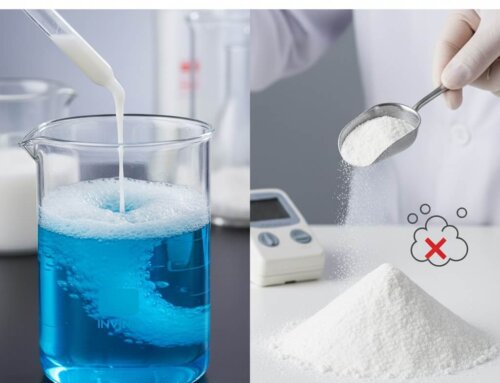
Foam is a serious problem across textile wet processing. It slows liquor circulation, causes uneven shades, and drives up auxiliary chemical use. The toughest conditions are in high-temperature high-pressure (HTHP) jet dyeing and strong-alkaline pre-treatment baths, where foam is hard to control. These stages need stable emulsions that resist surfactant displacement and won't "oil out".
INVINO® makes silicone emulsions, polyether-modified silicone emulsions, and non-silicone defoamers built to stay stable in harsh chemistry without separating. They knock down foam through desizing, scouring, bleaching, and finishing — without leaving silicone spots or oil stains on the fabric, in line with Oeko-Tex and APEO-free requirements.
Request a Free Sample
Key Application Areas for Textile Defoamers
Controls heavy chemical foam in textile pulp milling and slurry hydration, preventing pipeline air locks.
Holds stable foam control in scouring, bleaching, and concentrated NaOH refining baths.
Withstands high pump shear and heat up to 130°C without breaking phase or leaving silicone spots.
Removes macro-foam and entrained air in softeners, auxiliary blending, and high-viscosity printing / sizing pastes.
Defoamer Selection Matrix for Textile Industries
| INVINO PRODUCT | CHEMICAL TYPE | ACTIVE SOLID (%) | Application / Best For | TECHNICAL FILES |
|---|---|---|---|---|
| INVINO-2430 | Silicone Emulsion | 30% | Standard textile pulp loops, raw pulp hydration, and basic liquid blending circuits. | DOWNLOAD TDS |
| INVINO-6100N | Silicone Emulsion (Alkali-Resistant) | 30% | Pre-treatment loops and low-foaming refining agents; stays stable under strong alkali (concentrated NaOH). | DOWNLOAD TDS |
| INVINO-6200 | Silicone Emulsion (Polyether-Modified) | 20% | High-temperature overflow / HTHP jet dyeing. Stable through continuous 130°C loops without oil separation. | DOWNLOAD TDS |
| INVINO-1332A | Silicone Compound | 100% | Textile finishing, high-solids softener compounding, and auxiliary blending lines. | DOWNLOAD TDS |
| INVINO-3000 | Mineral Oil | 100% | Textile printing, fabric sizing, and zero-silicone high-viscosity paste processing. | DOWNLOAD TDS |
Technical FAQ for Textile & Dyeing Engineers
Will this defoamer cause "silicone spots" or oil stains on the fabric?
A: Silicone spots happen when an unstable silicone emulsion splits or oils out under shear or heat. INVINO-6200 is cross-link stabilized to keep a uniform emulsion through the whole dyeing cycle, so it does not precipitate oil onto the fabric.
Is it suitable for High-Temperature High-Pressure (HTHP) Jet Dyeing Machines?
A: Yes. Low-end antifoams break at their cloud point inside pressurized vessels. Our dyeing grade INVINO-6200 is built to stay stable through continuous 130°C dyeing and reliably collapse foam.
Can it be used in Pre-treatment processes (Scouring & Bleaching)?
A: Yes. Scouring uses concentrated sodium hydroxide that breaks ordinary surfactants. INVINO-6100N is alkali-resistant and stays stable at high pH and high salt.
Will the defoamer affect the dyeing shade or cause uneven dyeing?
A: No. The grades are surface-inert toward direct, reactive, and disperse dyes, so they do not cause spotting and keep a level, uniform shade.
Is the product free from APEO and compliant with Oeko-Tex standards?
A: Yes. INVINO® textile defoamers are formulated free of alkylphenol ethoxylates (APEO) and heavy metals, supporting Oeko-Tex compliance for export fabrics.
Request Your Textile Defoamer Solution
Standard Protocol for Textile Sample Verification
System Parameter Submission
Share your process stage (pre-treatment, dyeing, printing), temperature, pH, and fabric/fiber type.
Free Lab Test (Cyclic Bubbling + Centrifugation)
Our textile lab runs a cyclic bubbling test and high-speed centrifugation stability check to match a spot-free grade — free of charge.
Free Sample Dispatch
Free trial samples ship via air express for jet dyeing and scouring trials. No MOQ at sample stage; buyer covers freight, refunded on the first bulk order.