Defoamer for Potassium Chloride (KCl) Cold-Crystallization Flotation
Potassium chloride (KCl) is one of the most widely used potash fertilizers globally. In salt-lake regions — the Middle East, North Africa, and Western China — the cold-crystallization flotation process is a mainstream method for extracting KCl from carnallite (KMgCl₃·6H₂O) and sodium chloride (NaCl) mixed deposits.
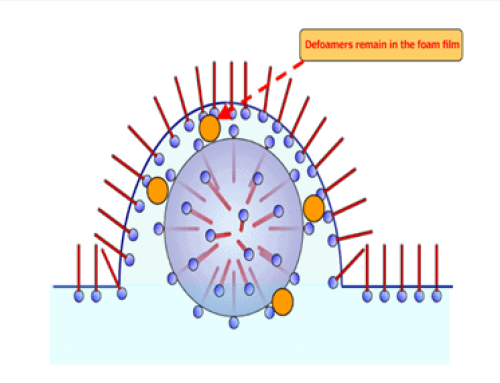
In this process, froth flotation separates NaCl impurities from KCl-rich solutions. But surface-active flotation agents introduce excessive foam, causing production and safety problems. This guide outlines how to select the right KCl flotation defoamer, based on real plant experience.

Process Overview: How Foam Forms in KCl Flotation
Based on plant data, the KCl system using cold-crystallization flotation typically follows these steps:
1. Mud Depressant Conditioning Tank
- Coagulants/flocculants added to remove clay and silicate impurities.
- High-shear agitation for ~1.5 min to promote dispersion.
2. Flotation Reagent Conditioning Tank
- Injection of flotation agents, mainly alkylmorpholine-based cationic surfactants.
- This step is a primary source of foam, due to rapid surface-tension reduction.
3. Flotation Cells
- Air injected into the slurry; NaCl adheres to bubbles and floats up.
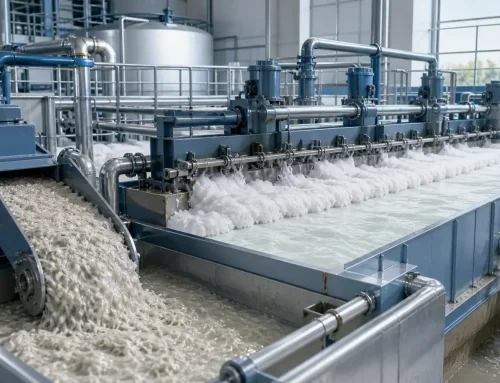
- Froth is skimmed off; excessive froth may overflow and disturb downstream operations.
4. Tailings Tank
- Remaining slurry collects in the tailings section; residual foam is less critical at this stage.
Operating Conditions & Foaming Challenges
| Parameter | Value / Range |
|---|---|
| Solids Content | Diluted from 45% to 18-23% |
| Temperature | ~30°C in summer, ~17°C in winter |
| pH Value | Approximately 5.0 (weakly acidic) |
| Foaming Stage | Severe foaming occurs in flotation tanks |
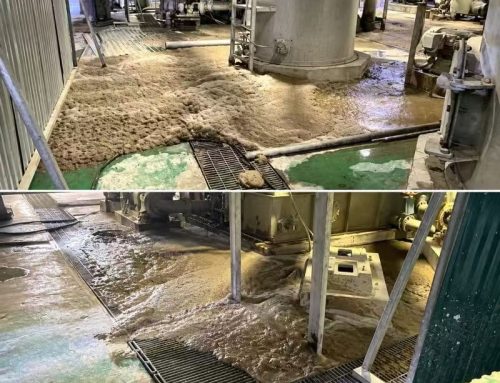
| Foam Issues | Impacts pump suction, causes overflow, reduces separation efficiency |
Why Foam Control Is Crucial in Flotation
- Reduced separation efficiency: excess foam hinders selective binding of mineral particles to air bubbles.
- Equipment malfunctions: foam disrupts level sensors and skimming paddles, causing instability or shutdowns.
- Reduced throughput: foam displaces liquid volume in flotation cells, reducing slurry processed.
- Safety & maintenance risks: overflow causes slippery floors, electrical hazards, and corrosion from chemical residues.
How to Select the Right Defoamer for KCl Flotation
| Requirement | INVINO Recommendation |
|---|---|
| pH Compatibility | Stable in pH 3-9, ideal for weakly acidic flotation slurries |
| Temperature Range | Effective at 10-40°C, especially low-temp winter operation |
| Foaming Agent | Compatible with alkylmorpholine-based cationic surfactants |
| Non-Silicone Preference | Non-silicone options preferred to avoid flotation interference |
| Emulsion-Free | Clear solutions recommended to prevent instability |
| No Residue / Stickiness | Clean system performance, no tank fouling or filter clogging |
INVINO-8061: Recommended Formulation for KCl Flotation
INVINO-8061 — Non-Silicone Polyether Clear Liquid Defoamer (Flagship)
- Composition: balanced EO/PO polyether + fatty-alcohol polyether synergist
- Appearance: transparent, non-emulsified clear liquid
- Performance: stable pH 3-10, effective 10-40°C, excellent long-lasting suppression
- Advantages: rapid dispersion in high-solids slurries; strong compatibility in weakly acidic, low-temperature conditions; non-silicone — no flotation interference; no residue or floating scum
Proven in salt-lake flotation plants and mining operations across Asia and the Middle East.
INVINO-8061 — Customized Polyether-Fatty Ether Synergistic System
- Design basis: tailored for systems with extreme foam stability or seasonal temperature variation.
- Composition: modified polyether backbone + C12-C16 fatty ether.
- Application: systems with long retention time or turbulent flow; plants needing extra foam suppression in winter conditions.
INVINO in-house testing and customer feedback confirm this type enhances foam suppression without disrupting reagent performance or product purity.
View our polyether defoamer range →
Dosage & Application Guidelines
| Application Point | Suggested Practice |
|---|---|
| Primary Dosage Location | Reagent Conditioning Tank (before flotation cells) |
| Secondary (optional) | Injection into flotation feed pipeline |
| Recommended Dosage | 0.1-0.3% of total slurry volume (lab trial advised) |
For optimal performance, pre-dilute the defoamer with process water and add via metering pump for even distribution.
Why INVINO Is Your Trusted Partner for Flotation Foam Control
In KCl production via cold-crystallization flotation, foam control is critical for process efficiency, equipment longevity, and product quality. Foam from surfactant-based flotation agents like alkylmorpholine can cause major disruptions if not managed. INVINO offers defoamer solutions that are:
- Designed for low pH and low temperature
- Non-silicone, clean, and flotation-safe
- Field-proven in salt-mining and brine processing applications
Q&A: Optimizing KCl Crystallization & Flotation
Q: Will the defoamer interfere with the flotation collectors (amines)?
A: No. INVINO-8061 is non-silicone and controls foam without interfering with alkylmorpholine/amine collectors, so it does not reduce NaCl separation.
Q: Is it effective in saturated brine at low temperatures?
A: Yes. Effective 10-40°C including low-temp winter operation in saturated KCl brine, with rapid dispersion in high-solids slurries.
Q: Does it affect the recycling of the mother liquor?
A: No. As a non-silicone, low-residue clear liquid it leaves no floating scum, so it does not disrupt mother-liquor recycling.
Q: How does it improve crystallizer performance?
A: By eliminating foam and scum in flotation/conditioning, it stabilizes level control and slurry flow, supporting consistent crystallizer performance.
Q: Will residues affect the purity or color of the final potash fertilizer?
A: No. It leaves no residue or stickiness, so it does not affect the purity or color of the final KCl product.