Antifoam Mechanism Explained: Definition, Types & Factory Guide
Direct Answer
An antifoaming agent works when active droplets disperse through the liquid, enter a foam film, spread or bridge across it, and promote thinning until the bubble ruptures. Effective action requires lower interfacial tension and controlled incompatibility: a product that is too compatible may remain dissolved and inactive, while one that is too incompatible can separate or cause surface defects. Evaluate entry and spreading behavior indirectly under real shear, temperature and formulation conditions by comparing rapid foam knockdown, suppression over time, dispersion, residue and final product quality.
Last updated: August 2026
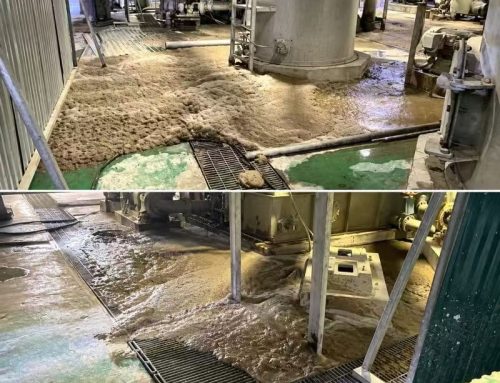
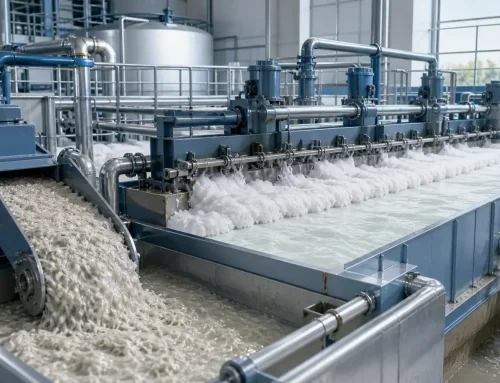
Foam is a common challenge across countless industries, from [ wastewater treatment] to [ paper & pulp]. It can reduce process efficiency, damage equipment, and compromise final product quality.
Antifoaming agents (also known as defoamers) are the chemical solution to this problem. But how do they actually work?
Understanding the science behind foam control is the first step to selecting the right product. This guide will explain the complete mechanism of antifoam agents, from core principles to the step-by-step process of a bubble bursting.
What is an Antifoaming Agent?
An antifoaming agent is a chemical additive designed to prevent foam formation in industrial process liquids. It functions by reducing surface tension at the air-liquid interface, destabilizing bubble walls to stop foam before it starts, ensuring efficiency and product quality.
Antifoaming vs. Defoaming: What is the Difference?
While the terms are often used interchangeably in the industry, there is a distinct technical difference based on when they are applied:
-
Antifoaming Agent (Prevention): Added to the liquid system before foam is generated. Its primary function is to prevent foam bubbles from forming in the first place.
-
Defoaming Agent (Destruction): Added to the liquid after foam has already formed. Its primary function is to rapidly “knock down” or destroy existing foam.
Here is a quick comparison:
| Feature | Antifoam | Defoamer |
|---|---|---|
| Timing | Added Before foaming | Added After foaming |
| Primary Goal | Prevention (Stop foam formation) | Suppression (Destroy existing foam) |
| Action | Inhibits bubble stability | Ruptures bubble film immediately |
🏭 Factory Note: In actual industrial production, the distinction is becoming blurred. Most modern high-performance agents, like our [Silicone Defoamers], are formulated to perform both functions: they knock down existing foam quickly and provide long-lasting antifoaming performance to prevent recurrence.
The Core Principles: Entering (E) & Spreading (S) Coefficients
For an antifoam agent to work, it must be able to do two things: enter the bubble wall (the foam lamella) and then spread across it. These actions are governed by two key parameters:
-
Entering Coefficient (E): This determines if the defoamer droplet can penetrate the bubble wall. For it to work, the E value must be positive (E > 0).
-
Spreading Coefficient (S): This determines if the defoamer, once it has entered, will spread across the film surface. For it to work, the S value must also be positive (S > 0).

Understanding the Antifoam Mechanism: How it Works?
Let’s visualize the process. Studies on polysiloxane (silicone) defoamers show a clear, multi-step action:
-
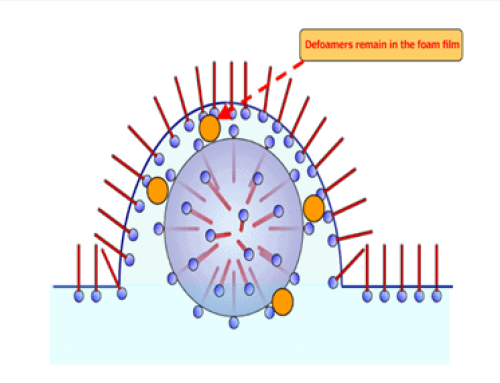
Adhesion & Entering: The antifoam droplet, which is insoluble, makes contact with the bubble film. Because its Entering Coefficient (E) is positive, it pierces the film’s surface.
-
Spreading & Bridging: Once inside, the positive Spreading Coefficient (S) causes the agent to spread rapidly across the surface of the film. This action creates a “bridge” and pulls the stabilizing surfactant away, locally thinning the bubble wall.
-
Thinning & Merging: As the defoamer spreads, the bubble film becomes progressively thinner and weaker. The single droplet may merge with others to form larger, more disruptive “lenses.”
-
Rupture: The bubble wall becomes so thin that it is no longer stable. It bursts. The gas is released, and the foam collapses. The antifoam agent is then free to move and attack the next bubble.
The “Secret Weapon”: Hydrophobic Solid Particles
Many high-performance [ silicone defoamers] contain more than just oil. They include hydrophobic solid particles, such as fumed silica treated with methyl silicone oil, silazane, or DMC.
These particles are the “shock troops” of the defoaming mechanism:
-
The hydrophobic particles are carried by the antifoam oil.
-
The surfactant in the foam (which has a hydrophilic end) is attracted to the particle surface.
-
This interaction helps the oil droplet pierce the bubble wall more aggressively. The solid particle acts like a “needle,” creating a weak point that accelerates the film’s rupture.
Therefore, antifoaming agents containing hydrophobic silica generally have better and faster defoaming effects.
Other Important Antifoam Mechanisms
While the spreading and solid-particle mechanisms are primary, other factors also contribute:
-
Solubilizing the Foaming Surfactant: Some low-molecular-weight substances can “steal” or solubilize the surfactant that stabilizes the foam. This reduces the surfactant’s effective concentration, weakening the bubble wall and making it easier to break.

- Electrolyte Disintegration: In systems where foam is stabilized by the mutual repulsion of an electric double layer, adding ordinary electrolytes can collapse this layer, leading to bubble coalescence and bursting.
The Mathematical Logic of Foam Bursting
For an antifoam to effectively rupture a bubble wall, it must satisfy two thermodynamic conditions:
- 1. Entering Coefficient (E): E = γf + γdf - γd > 0
- 2. Spreading Coefficient (S): S = γf - γdf - γd > 0
* γf: Surface tension of the foaming medium; γd: Surface tension of the defoamer; γdf: Interfacial tension between them.
4 Common Types of Antifoaming Agents
Silicone Antifoams (Polysiloxane)
High efficiency, thermal stability. can be used in wide range of industries, such as: waste water treatment, paper pulp….
Polyether Antifoams
Good compatibility, non-toxic. Ideal for Fermentation, Construction and Sugar processing.
Mineral Oil Defoamers
Cost-effective. Commonly used in Paints & Coatings
Fatty Alcohol Defoamers
Acts as a powerful degassing agent, primarily used in the Paper Machine Wet End to remove entrained air.
Factory Insight: Why Lab Tests Pass but Production Fails?
Critical Warning: Why Your Lab Samples Might Fail in the Field
| Shear Stress | Lab shakers provide low shear. High-speed pumps in factories can break emulsions, leading to oil slicking. |
| Cloud Point | If factory temperatures exceed the defoamer’s cloud point, the active polyether will precipitate and lose efficacy. |
| Time Lag | Standard 5-minute tests ignore long-term chemical compatibility with other surfactants over a 24-hour cycle. |