Why Does Roller-Applied Waterborne Paint Show Pinholes When the Cup Looks Clear?
INVINO technical guide · November 11, 2026
A clear surface in the mixing cup tells you that little foam is visible there. It tells you much less about what happens when a roller works air into a thin film. Before increasing the defoamer dose, apply the same paint two ways: draw it down with a film applicator, then roll it onto a matching panel. Watch when the first bubbles or pits appear. That observation is more useful than a photograph of the dry defect alone.
Make one comparison you can interpret
Start with the waterborne paint that produced the complaint, at its normal application viscosity. Use two clean panels of the same substrate and preparation. For a first check, leave the formulation unchanged. Panel A gets a drawdown; panel B gets the roller used on the job, or the closest equivalent. Match wet film thickness as closely as practical and record the measured thickness. If one film is much thicker, repeat the comparison before attributing the difference to the roller.
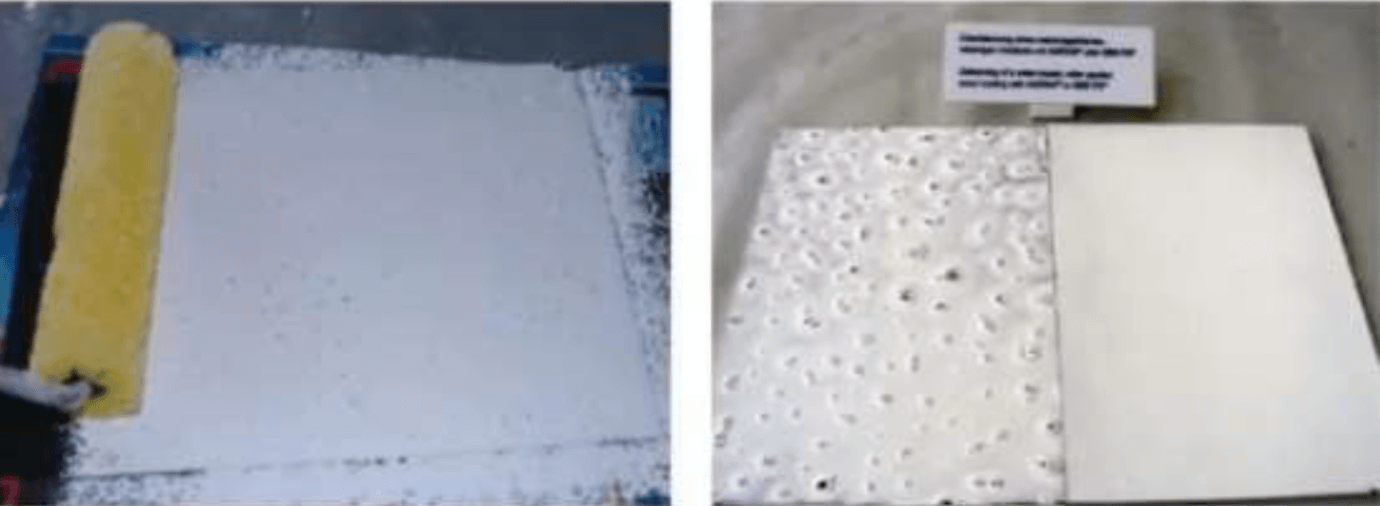
Inspect a marked area on each panel immediately after application, while the film is still open, and again when dry. Photograph the same area in the same light. Can you follow a bubble as it opens and leaves a hole? Or does the liquid pull away from a spot without a visible bubble? A missed bubble is possible; treat either observation as a clue.
| What you see | What to try next |
|---|---|
| The drawdown dries clean. Bubbles appear behind the roller, and holes remain at those locations. | Keep the paint unchanged. Compare the normal roller pass with a second, controlled application in which you change only roller loading or the number of passes. Check thickness again. |
| Fine bubbles are visible in both wet films before holes form. | Compare matched portions applied at the normal process age and after a documented rest. If resting helps, look at mixing, transfer and the time available for air to escape. Do not assume the production line can accommodate that rest. |
| Round depressions appear as the paint draws away from spots. You did not see bubbles there. | Repeat on a fresh, clean substrate with clean tools and a retained reference paint if available. Investigate wetting, contamination and additive compatibility before increasing the dose. |
| Neither panel reproduces the defect. | Go back to the job conditions: actual substrate and primer, paint age, roller cover, film build and drying conditions. A clean lab panel alone cannot qualify a replacement grade. |
When is it worth changing the defoamer?
Once the reference paint reproducibly fails the relevant panel test, divide a common base into matched portions. Keep the current formulation as the benchmark. Compare one candidate using the supplier’s incorporation guidance, recording the amount as supplied, the addition stage and the mixing history. If the candidate requires a different process, label that trial as a grade-and-process comparison. It cannot isolate the effect of the grade alone.
Repeat the two-panel comparison for each portion. Select against the actual acceptance criterion: for example, fewer persistent holes in the rolled film and no new craters in the drawdown. Agree on the inspection area, drying interval and finish requirements before reviewing the panels. Repeat a promising result on independently prepared portions and after a storage interval relevant to the job.
For background, BYK explains why application tests are useful alongside liquid foam tests and how defoamer compatibility and incorporation affect film quality. The paired-panel exercise above is a troubleshooting comparison, not a standardized pass/fail test.
What to send with a sample request
Identify the binder family and substrate, current grade and dose, addition point, age of the paint and roller type. Include the wet film thickness and paired wet/dry photographs labeled “drawdown” and “roller.” If you have only the finished panel, say so: the missing observation is what the wet film did before the defect appeared.
Use the paint defect and testing guide for background methods. To discuss defoamer options for waterborne coatings, send your trial conditions to INVINO and identify which panel you need the candidate to improve.