Why Does a Formulation Turn Cloudy After Adding a Defoamer?
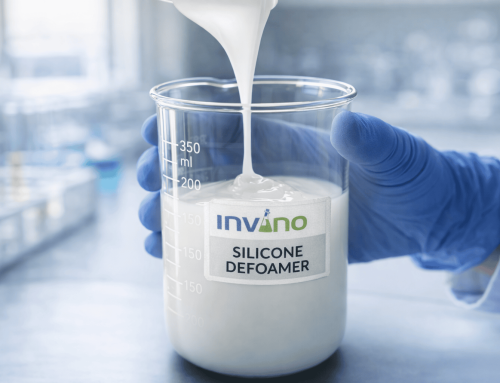
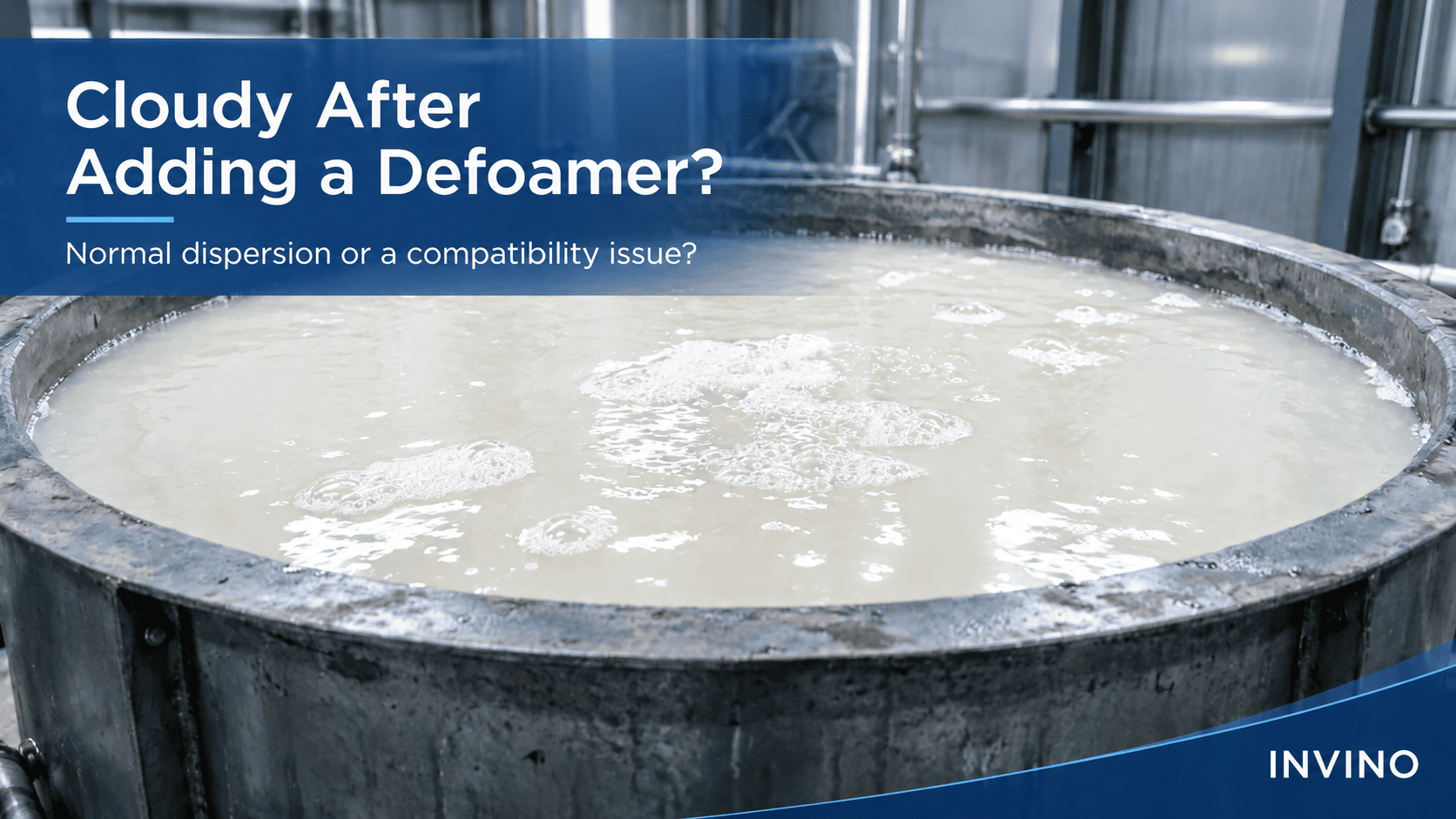
Not always. A clear formulation can become milky, hazy or slightly cloudy when a defoamer is dispersed into it. This change alone does not prove incompatibility.
Most defoamers need controlled incompatibility with the liquid phase so that active droplets can reach the foam interface. The practical question is whether the haze remains uniform or develops into separation, performance loss or defects in the finished product.
Evaluate foam control, physical stability and final product quality together. Do not accept or reject a defoamer from appearance alone.
Why an Effective Defoamer Is Not Fully Compatible
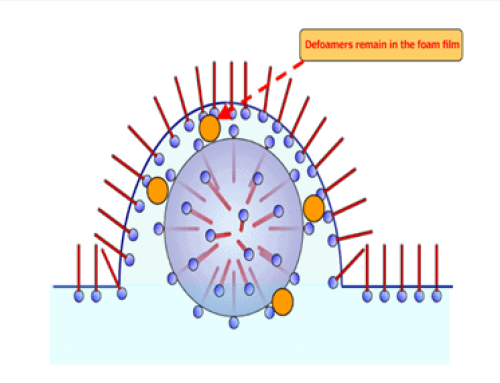
A defoamer normally does not dissolve into a formulation like a salt or a small solvent molecule. It remains as a separate, finely dispersed phase. Its droplets must reach the air-liquid interface, enter the foam film and help destabilize it.
If a defoamer is too compatible, it can remain distributed throughout the liquid instead of concentrating where foam needs to break. Foam control may then weaken. If it is too incompatible, droplets can become large enough to scatter light or collect as oil, flocs or sediment.
Compatibility is therefore a balance, not a yes-or-no property. A formulation can show temporary haze while maintaining stable foam control and acceptable final quality. The same appearance becomes unacceptable if it progresses during storage or creates defects during downstream use.
The acceptance limit depends on the formulation, process and final quality requirement. A clear coating, a paper-process liquid and a wastewater stream do not use the same visual criteria.
Four Common Reasons a Formulation Turns Cloudy
1. Uneven dispersion
Most defoamers enter the formulation as droplets rather than as a dissolved component. If the product is added too quickly, introduced at a poorly mixed location or given insufficient incorporation, the local concentration can become much higher than the average dosage.
The immediate result may be haze, visible agglomerates or localized oily streaks. If controlled mixing restores a uniform appearance and no layer forms during the relevant standing period, the observation points first to an incorporation issue. It does not yet prove long-term compatibility.
2. Changes in the dispersed defoamer phase
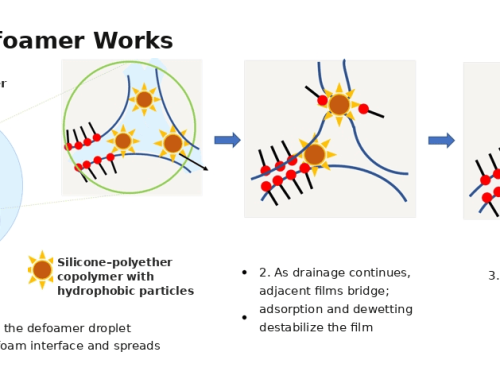
Some silicone-based defoamers combine a silicone phase with hydrophobic particles such as treated silica. During incorporation and foam control, shear and contact with the formulation can change how these components are distributed.
A change in droplet or particle distribution changes light scattering. The liquid can therefore look more turbid while the defoamer continues to control foam. Observe the sample over time because redistribution can also progress into separation in an unsuitable system.
3. A genuine formulation mismatch
Compatibility can shift with pH, temperature, surfactants, electrolytes, solvents, binder chemistry and shear. A defoamer that remains dispersed in one formulation may separate in another, even when both systems are water-based.
Look for progression. Persistent haze accompanied by floating oil, flocculation, sediment or weaker foam control is stronger evidence of incompatibility than a stable, uniform haze alone.
4. Excessive dosage or an unsuitable addition point
More defoamer does not automatically produce better control. After the formulation-specific useful range is reached, additional incompatible material may increase haze, separation, tackiness or surface defects without providing a proportional foam-control benefit.
Addition point also matters. A concentrate, an emulsion and a fully active defoamer may respond differently to shear. Record where the product was added, the order of addition, temperature and mixing conditions. Change one variable at a time in the next trial.
Temporary Haze or Compatibility Problem?
Use the behavior of the system, not one visual snapshot, to decide what the cloudiness means.
| Accept or continue monitoring | Investigate further |
|---|---|
| The formulation becomes uniform after the intended mixing step. | Haze remains uneven or continues to increase after sufficient mixing. |
| No oil layer, sediment or flocculation appears during the relevant observation period. | Floating oil, sediment, agglomerates or flocs appear. |
| Initial foam knockdown and longer-term suppression remain consistent with the test target. | Foam knockdown or antifoaming persistence becomes weaker. |
| Pumping, coating, spraying, filtration or other downstream processing remains normal. | Filters block, deposits form or process behavior changes. |
| The finished product meets its defined appearance and performance requirements. | The finished product develops gloss loss, tackiness, craters, fish-eyes, adhesion loss or another specified defect. |
A slight, stable haze may be acceptable in an opaque process liquid but unacceptable in a clear coating or transparent adhesive. Define the acceptance criteria before comparing candidates.
If the formulation becomes uniform but foam performance falls, excessive compatibility is one possibility. Also check dosage, shear and addition order. If foam control remains strong but defects appear, the defoamer may be too incompatible for that use condition.
The target is stable foam control without an unacceptable effect on the process or finished product. Maximum clarity and maximum foam knockdown are not independent acceptance criteria.
A Practical Bench Check Before You Reject the Defoamer
Run a controlled comparison before changing products. The purpose is to determine whether the result comes from the defoamer, its incorporation or another formulation variable.
- Prepare an untreated control and matched test samples. Use the same formulation batch and identical containers. Keep one sample without defoamer so that the base formulation's natural haze, foam and storage behavior remain visible.
- Hold the main variables constant. Use the same sample mass, temperature, mixing equipment, fill level and observation conditions. When different defoamer types are compared, keep the mixing method consistent.
- Record incorporation conditions. Note the dosage, addition point, order of addition, mixing duration and qualitative shear level. Do not rely on memory after the test.
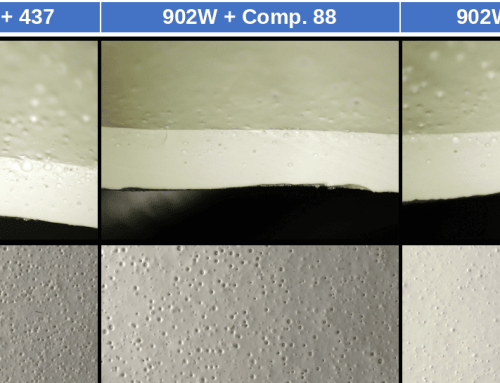
- Observe immediately and after standing. Record whether the sample becomes uniform, remains evenly hazy or develops a separate layer, flocs or sediment. Photograph every sample under the same lighting and background.
- Compare knockdown and persistence. Check initial foam reduction and the ability to resist foam during continued or repeated agitation. A clear sample with weak foam control is not automatically the better result.
- Check the downstream quality that matters. Apply, pump, filter, coat or otherwise process the sample in a way that represents actual use. Inspect the final product against defined criteria such as gloss, surface appearance, adhesion, filtration behavior or deposit formation.
- Change one variable in the next trial. If haze is the only concern, compare a lower controlled dosage or a different addition point while holding the remaining conditions constant. This helps separate overdosing and incorporation effects from a chemistry mismatch.
Frequently Asked Questions and the Next Step
Q: Is slight haze always a sign that a defoamer is incompatible?
A: No. Slight or temporary haze can result from the dispersed defoamer phase. It may be acceptable if the system becomes uniform, remains physically stable, controls foam and does not affect downstream processing or final product quality.
Q: Will adding more defoamer remove foam more effectively?
A: Not necessarily. Increasing the dosage may improve foam control only within a formulation-specific range. Excess material can increase haze, separation or surface defects. Compare controlled dosage steps and select the lowest level that meets both foam-control and quality requirements.
Q: Can a silicone defoamer make a formulation look cloudy?
A: Yes. Silicone droplets and, in some products, hydrophobic particles can scatter light when dispersed in the formulation. Evaluate the appearance together with separation, foam performance and the quality of the finished product.
Q: What information is needed to investigate a cloudiness problem?
A: Provide the formulation type, pH, temperature, relevant surfactants or electrolytes, defoamer name and dosage, addition point, mixing conditions, timing of the haze, photos after defined standing periods, foam-control results and any downstream defects.
Technical references
Request a Compatibility Review
Send your formulation type, pH, temperature, defoamer dosage, addition point, mixing conditions and observed changes. The existing INVINO technical inquiry form will be inserted here during WordPress deployment.