Defoamer Types Compared: Silicone vs Polyether vs Fatty Alcohol vs Mineral Oil
Selecting a defoamer is not about the brand on the drum — it is about matching foam-control chemistry to your process conditions. The wrong type costs you quickly: foam that rebounds soon after dosing (poor antifoam persistence), a product that breaks down under high temperature or high alkalinity, or silicone carry-over that leaves fish-eyes and craters in a coating. This guide compares the four main defoamer families on the parameters process engineers actually specify, and shows you how to shortlist the right chemistry for your system.
The Four Defoamer Types at a Glance

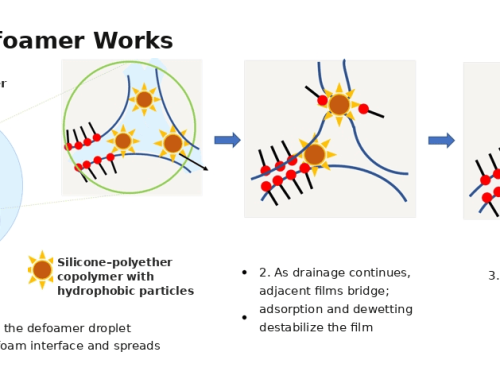
Every defoamer works by spreading across the foam lamella, displacing the stabilizing surfactant and rupturing the bubble film. What separates the families is how fast they knock foam down, how long they suppress it, and how well they survive heat, alkalinity and shear.
1. Silicone Defoamers & Antifoams
Built on polydimethylsiloxane (PDMS) with a hydrophobic silica hydrophobe, silicone defoamers deliver the fastest knockdown at the lowest dosage of any family — ideal for wastewater aeration basins, pulp & paper, textile and fermentation. The trade-off: in sensitive coating and ink systems, silicone carry-over can cause fish-eyes and craters, so residue control is critical.
2. Polyether (EO/PO) Defoamers
Polyether defoamers use EO/PO block or end-capped polyethers and are the strongest performers in high-temperature and high-alkali environments. Their cloud-point mechanism becomes more active as temperature rises — which is why they dominate in sugar evaporation, pressurized fermentation, high-temperature (130°C) jet dyeing and alkaline scrubbers. Excellent persistence and high-shear stability, with low residue risk.
3. Fatty Alcohol Defoamers
Fatty alcohol defoamers deliver fast, spot-free break of coarse foam and are a favorite in paper coating, where avoiding fish-eyes, craters and loss of transparency is essential. Silicone-free, cost-effective, and reliable in acidic and legacy systems — though persistence at very high temperature is more limited than polyether.
4. Mineral Oil Defoamers
Mineral oil defoamers combine fast knockdown with low cost, making them a practical choice where silicone is unwanted and budget matters — pulp & paper and many water-based coatings. Dispersed hydrophobic particles in a carrier oil provide dependable, silicone-free foam control.
Defoamer Type Comparison Matrix
Use the matrix below for a first-pass shortlist. Values are typical ranges; actual performance depends on your formulation, temperature, pH and shear.
| Property | Silicone | Polyether (EO/PO) | Fatty Alcohol | Mineral Oil |
|---|---|---|---|---|
| Foam knockdown speed | Very fast | Moderate–good | Fast (coarse foam) | Fast |
| Antifoam persistence | Good–excellent | Excellent | Moderate | Good |
| High-temperature resistance | Good (~150°C+) | Excellent (best hot) | Moderate | Moderate |
| High-alkali / high-pH resistance | Good | Excellent | Moderate | Moderate |
| High-shear stability | Good | Excellent | Moderate | Moderate–good |
| Surface-defect / residue risk | Higher (coatings) | Low | Low | Low (silicone-free) |
| Food-grade grades available | Yes | Yes | Some | Limited |
| Typical dosage efficiency | Very low dose | Low–moderate | Moderate | Moderate |
| Relative cost | Mid | Mid–high | Low–mid | Low |
| Best-fit applications | Wastewater, pulp & paper, textile, fermentation | Fermentation, sugar, high-temp/alkali cleaning, wet-end | Paper coating (spot-free), acidic systems | Silicone-free coatings, pulp & paper, cost-sensitive |
How to Match a Defoamer to Your Process
The type comparison above narrows your options; the next step is matching that type to your exact conditions. For a deeper, formulation-specific walkthrough, see our guide on how to choose a defoamer for your formulation system.
By Temperature — High-Temp & Low-Temp Foam Control
For hot systems above ~80°C — evaporators, digesters, 130°C jet dyeing, high-temperature cleaning — polyether is usually the safest choice because its activity rises with temperature; silicone is a strong second. See our notes on how much heat a high-temperature defoamer can withstand. At low temperatures the logic flips: polyether can drop below its cloud point and lose activity, so fast-spreading fatty alcohol or a cold-process emulsion performs better.
By pH — High-Alkali & Alkaline-Scrubber Resistance
Alkaline scrubbers (pH 12+), caustic cleaning, strong-alkali textile dyeing and neutral/alkaline paper loops demand a chemistry that will not hydrolyze, separate or float oil. Polyether leads here, with silicone viable depending on the emulsifier system. Always confirm hydrolytic stability at your operating pH before scaling up.
By Residue Sensitivity — Coatings, Inks & Food Contact
Where silicone carry-over would cause fish-eyes, craters, spots or loss of transparency, choose a non-silicone family — fatty alcohol or mineral oil. For food and beverage processing, use a food-grade defoamer with the right compliance documentation (see below).
By Cost & Dosage Efficiency
Do not compare price per kilogram — compare cost per unit of foam controlled. Silicone often wins on total cost despite a higher unit price because its dosage is far lower. Mineral oil and fatty alcohol win where silicone is excluded or where budget is the binding constraint.
Common Foam Problems by Industry
| Industry | Core Foam Pain Points | Recommended Type |
|---|---|---|
| Wastewater | Biological aeration-basin foaming, COD/BOD impact, insufficient antifoam persistence | Silicone / Polyether |
| Paints & Coatings | Shear foaming in production, craters & fish-eyes on application, loss of transparency | Fatty Alcohol / Mineral Oil |
| Textile Dyeing | 130°C high-temp jet dyeing, strong-alkali resistance, no oil-floating, no spotting | Polyether |
| Pulp & Paper | Wet-end microfoam, pinholes, white-water recovery loss | Polyether / Mineral Oil |
| Fermentation & Sugar | High-temperature, high-shear foam; food-grade compliance | Polyether (food-grade) |
Backed by Documentation, Testing & Proven Supply
A defoamer recommendation is only as good as the data behind it. As a direct manufacturer, INVINO supports every grade with a full QA package — Certificate of Analysis (COA), Technical Data Sheet (TDS), Safety Data Sheet (SDS) — plus compliance reports covering heavy metals, PAHs, REACH SVHC and phthalates, alongside ISO 9001, food-grade and Halal certification.
↓ TDS & SDS Download ✓ Certificates (ISO/Food/Halal) ⇄ Cross-Reference Guide
Custom R&D & free lab testing: send your own foaming liquid to our China lab — our engineers run dynamic foam testing and formulate a tailored defoamer at no charge. Sample policy: samples (100–500 g) are 100% free; you cover courier (DHL/FedEx/TNT) or provide your own account, and we refund the freight on your first commercial order. Packaging: 25 kg pail, 200 kg drum, 1000 kg IBC; no MOQ at sample stage.



Frequently Asked Questions
What is the difference between silicone and non-silicone defoamers?
Silicone defoamers use PDMS oil with hydrophobic silica for very fast knockdown and low dosage, but can leave residues that cause fish-eyes or craters in coatings and inks. Non-silicone types (polyether, fatty alcohol, mineral oil) avoid that residue risk and are preferred where silicone contamination is a concern.
Which defoamer performs best at high temperature and high alkalinity?
Polyether (EO/PO) defoamers are the strongest choice for high-temperature and high-alkali systems such as alkaline scrubbers (pH 12+), 130°C jet dyeing, sugar evaporation and pressurized fermentation, because their cloud-point mechanism becomes more active as temperature rises.
Which defoamer avoids surface defects in paint and paper coating?
For coatings and paper coating where fish-eyes, craters and spotting must be avoided, non-silicone options such as fatty alcohol or mineral oil defoamers are preferred. Fatty alcohol types give fast, spot-free coarse-foam break at lower cost.
How do I choose a defoamer for a low-temperature process?
At low temperatures, polyether types may fall below their cloud point and lose activity. Fast-spreading fatty alcohol or specially formulated low-temperature emulsions maintain knockdown in cold processes; a lab trial is recommended.
What dosage should I start with, and can I test before buying?
Typical starting dosages range from 10 to 500 ppm depending on foam load and defoamer type, with silicone requiring the lowest dose. Optimal dosage should be confirmed by trial. As a direct manufacturer, INVINO provides free samples to validate performance before bulk supply.
Request a Free Sample to Test in Your System
Not sure which type fits your process? Our engineers will help you shortlist the right defoamer and ship a free sample for validation. Tell us your application, temperature, pH and foam type — we’ll handle the rest.