Low-Temperature Defoamer Selection: Foam Control in Cold Processes
Most defoamer data is quoted at ambient or elevated temperature — but if your process runs cold, that data can mislead you. Below roughly 10–15°C, many defoamers lose spreading speed, drop out of emulsion, or fall below their activation point, and foam that was controlled in summer suddenly breaks through in winter. This guide explains why defoamers fail in the cold and which chemistry keeps foam down in chilled water treatment, cold-fill beverage lines, low-temperature cleaning and winter construction.
Why Defoamers Fail at Low Temperature
Cold conditions attack defoamer performance through four mechanisms:
1. Below the cloud point
Polyether (EO/PO) defoamers rely on a cloud-point mechanism: they become active when they phase-separate above a threshold temperature. In the cold they can stay fully soluble, remain dispersed, and simply stop working — the opposite of their high-temperature strength.
2. Slower spreading & higher viscosity
Foam knockdown depends on rapid spreading across the bubble film. Low temperature raises carrier viscosity and slows spreading, so knockdown becomes sluggish and persistence drops.
3. Hydrophobe crystallization
Some waxy or fatty hydrophobes can crystallize or separate near their melting range, weakening the active particles that rupture foam films.
4. Emulsion instability & freezing
Water-based emulsions can break or freeze during cold storage and transport, causing phase separation before the product ever reaches the tank.
Which Defoamer Types Work Best in the Cold
| Type | Cold-Process Behavior | Best Use Below ~10°C |
|---|---|---|
| Fatty alcohol | Fast spreading, reliable cold knockdown | Coatings, paper, cold cleaning |
| Mineral oil | Good, if freeze-protected | Silicone-free cold coatings, pulp |
| Silicone (emulsion) | Good knockdown; watch emulsion freeze-thaw | Wastewater, general cold water systems |
| Polyether | May go inactive below cloud point | Only with a low-cloud-point grade |

Explore the silicone-free options that perform in the cold: fatty alcohol defoamers and mineral oil defoamers. For hot systems, the logic reverses — see our high-temperature defoamer guide.
Key Low-Temperature Applications
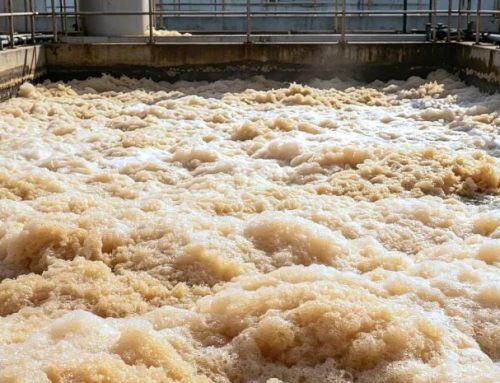
Cold-process foam problems show up across industries: chilled biological wastewater treatment where aeration foam still forms despite low temperature; cold-fill beverage and dairy lines needing a food-grade defoamer; low-temperature CIP and alkaline cleaning; and winter concrete admixtures where construction defoamers must remain active and freeze-stable on site.
Formulation & Handling Tips for Cold Conditions
Beyond picking the right chemistry, cold operation demands the right handling: store emulsions with freeze protection, respect the stated shelf life (typically 6–24 months), and gently re-homogenize any product that has been chilled before dosing. Dose slightly upstream of the coldest, highest-agitation zone so the defoamer has time to spread. Our packaging — 25 kg pail, 200 kg drum and 1000 kg IBC — ships with freeze-aware logistics on request.
Validate Before You Scale
Cold performance cannot be assumed from a room-temperature spec sheet. Send us your foaming medium and we will run dynamic foam testing at your actual process temperature in our China lab and formulate a tailored low-temperature defoamer — free of charge.
↓ TDS & SDS ✓ Certificates ⇄ Cross-Reference Guide




Frequently Asked Questions
Why does my defoamer stop working in winter?
At low temperature, polyether defoamers can fall below their cloud point and go inactive, while higher carrier viscosity slows the spreading that breaks foam. Switching to a fast-spreading fatty alcohol or a low-temperature emulsion usually restores knockdown.
Which defoamer is best for cold water treatment?
For chilled biological wastewater, a well-stabilized silicone emulsion or a fatty alcohol defoamer typically performs best; verify emulsion freeze-thaw stability if the product is stored cold.
Can polyether defoamers be used in cold processes?
Only with a grade specifically formulated with a low cloud point. Standard high-temperature polyether grades may remain soluble and inactive in the cold.
How should I store defoamer in freezing climates?
Keep emulsions above freezing, use freeze-protected logistics, observe the 6–24 month shelf life, and gently re-mix any product that has been chilled before dosing.
Request a Free Low-Temperature Sample
Tell us your process temperature, medium and foam type. Our engineers will shortlist a cold-active defoamer and ship a free sample (100–500 g) for validation — you cover courier or provide your own account, refunded on your first commercial order.