Optimizing Slurry Density in Fiber Cement Production: A Deaeration Solution Based on INVINO-8082A
Direct Answer
In fiber-cement board production, a deaerator should release entrained air from the slurry without destabilizing dispersion or impairing drainage and strength. Evaluate it in the actual cement-fiber-water-additive system at plant temperature and shear, measuring slurry density, foam height, drainage, board porosity, surface quality and mechanical properties. The best grade is the lowest dose that improves deaeration without causing separation or wetting defects.
Last updated: August 13, 2026
In the production of fiber cement boards—whether utilizing the Hatschek process or Flow-on technology—engineers frequently encounter a paradox: the surface foam is suppressed, yet the final board still exhibits structural flaws such as delamination, surface pinholes, and inconsistent dry density parameters.
The root cause is not surface foam, but Entrained Air matrix issues. At INVINO, we have developed a high-performance solution centered on INVINO-8082A-TDS, specifically engineered to address the micro-bubbles trapped within dense fiber-cement matrices. To evaluate comprehensive mechanical behavior attributes across alternative chemical configurations, explore our master reference profile via the Defoamers for Construction Industry main portal sheet.
Get Technical Guidance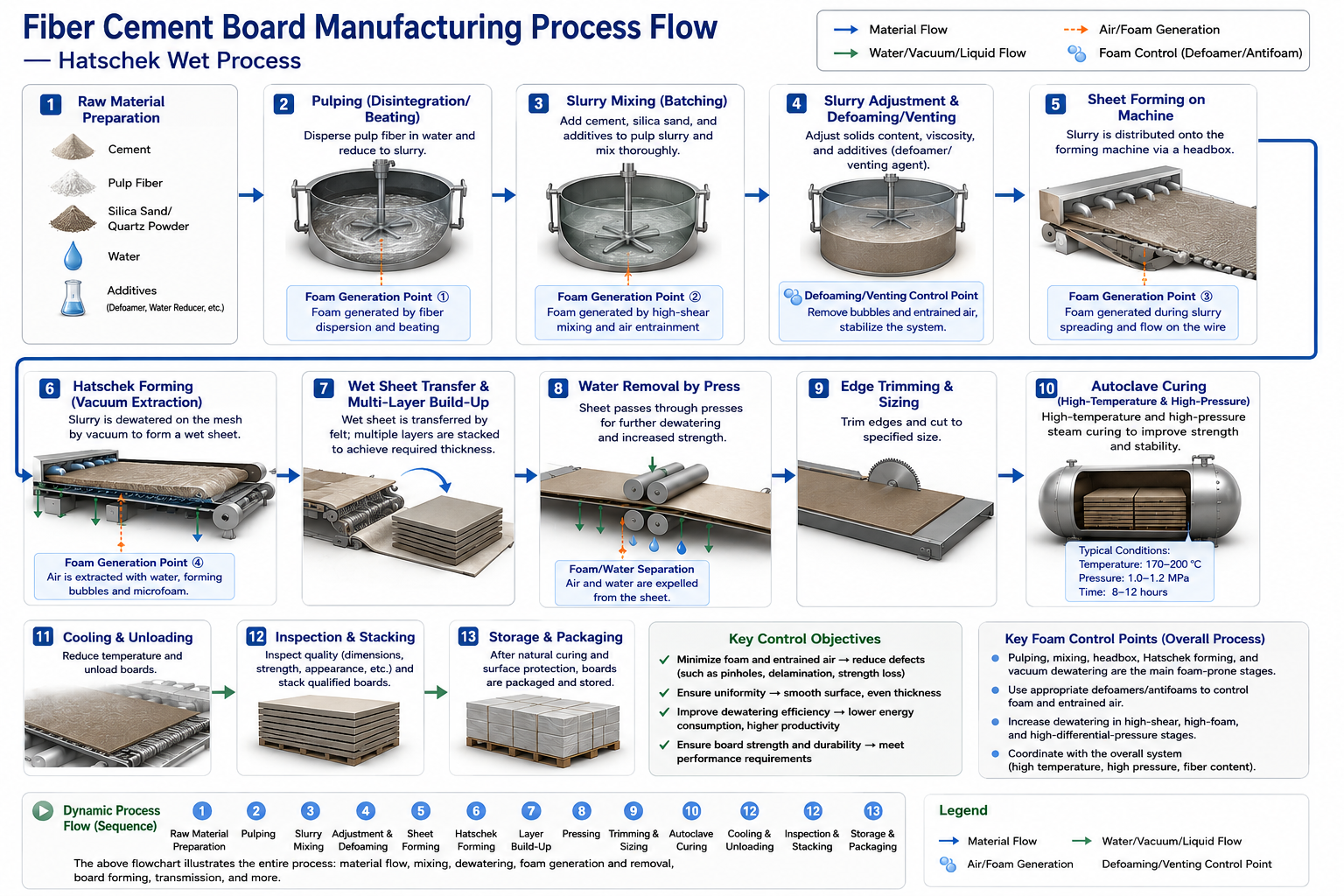
1. The Challenge: Why Surface Defoaming is Not Enough
Traditional defoamers often focus on "knocking down" visible bubbles. However, in a cementitious slurry with high solid content and fibrous reinforcement, microscopic air bubbles become physically trapped within the hydration network.
If these bubbles are not released before the forming stage, producers suffer continuous mechanical defects:
- Density Drop: Internal voids reduce the overall compact density of the finished board, leading to substandard weight parameters.
- Structural Weakness: Entrained air creates physical weak points, leading to reduced flexural strength metrics and an increased risk of layer delamination.
- Surface Defects: During the curing or hot-pressing phase, these micro-bubbles migrate under heat gradients, causing severe crater defects or pinholes on the board surface.
2. Technical Profile of INVINO-8082A
To solve the deep air problem, an active defoamer must possess specific chemical properties that can withstand the harsh alkaline environment of cement hydration parameters. To trace baseline material matching logs for ready-mix concrete or wet mortars, explore our dedicated Defoamers for Cement, Mortar, and Concrete工况 application gate. INVINO-8082A is formulated as a 100% active, solvent-free non-silicone deaerator compound.
| TECHNICAL RECONSTITUTION PARAMETER | INVINO-8082A SPECIFICATION ANALYSIS CRITERIA |
|---|---|
| Active Content Metric | 100% (Solvent-free, water-free active polymers) |
| Chemical Base Chemistry | Modified Polyether / Special Organic Blend |
| pH Stability Threshold | Stable in highly alkaline environments (pH 12.5 – 13.5) |
| Ionic Nature Profile | Non-ionic (Fully compatible with universal binder additives) |
| Appearance Profile | Light yellow translucent organic liquid |
Core Advantages for Industrial Plants:
Unlike standard silicone emulsions, INVINO-8082A does not suffer from emulsion breakage in high-pH matrices. This eliminates the risk of oil spots and ensures excellent adhesion for post-production coatings or laminations.
The modified polyether block structure lowers the liquid-fiber interfacial surface tension coordinates, forcing entrained micro-bubbles to merge rapidly via coalescence kinetics and escape cleanly.
With 100% active matter, INVINO-8082A offers a significantly lower cost-in-use metric compared to 20–30% diluted emulsions, reducing chemical storage footprints and global logistics freight costs.
3. Application Strategy in the Production Cycle
Based on empirical field data collected from automated operational production lines, we recommend a strategic tiered dosing approach to maximize continuous air evacuation metrics:
- Slurry Preparation (Mixing Stage): Adding INVINO-8082A during the initial mixing phase prevents the stability of foam layers created by intensive high-shear mechanical agitation.
- Headbox / Forming Section: This represents the critical Deaeration Zone. INVINO-8082A facilitates the instant evacuation of air from the slurry as it is distributed onto the wire screen, ensuring dense and uniform wet mat formulation.
- White Water Loop: INVINO-8082A maintains long-lasting anti-foaming properties within the closed recycling water system, preventing micro-air buildup, reducing vacuum pump cavitation, and optimizing dynamic gravitational drainage velocity indices.
4. Performance Data & Dosage Guidelines
In rigorous comparative laboratory tests and continuous field trials, INVINO-8082A has demonstrated a 3% to 5% improvement in slurry density parameters compared to untreated industrial batches.
Recommended Baseline Dosage:
- 0.1kg to 0.5kg per ton of finished fiber board product calculated on absolute dry weight parameters.
- Note: Precise addition coordinates should be determined via a standard graduated cylinder shake test or specialized air entrainment meter using your specific fiber-cement slurry water sample.
Technical FAQ: Fiber Cement Deaeration
Q: Why choose a 100% active deaerator like 8082A over a traditional emulsion?
A: Liquid emulsions typically contain 70–80% carrier water, which increases overseas logistics weight costs and carries an acute risk of phase separation during winter storage. INVINO-8082A is a 100% active non-aqueous liquid, offering higher concentrations, stable shelf life across high-pH shifts, and a significantly lower cost-in-use index per ton of finished boards.
Q: Will INVINO-8082A affect the adhesion of post-production coatings?
A: No. Unlike ordinary silicone-based defoamers which trigger split residues or oil spots that hinder surface paint and lamination adhesion, 8082A is 100% non-silicone. It remains completely compatible with the hydraulic cement matrix and leaves zero slick marks that would interfere with secondary surface coatings. Review our manufacturing core standards via our master FAQ Core Antifoams Knowledge Base gateway.
Q: How does 8082A improve the dry density of the board?
A: 8082A acts as a dedicated deaerator by lowering the boundary surface tension coordinates at the liquid-to-cellulose fiber interface. This mechanism allows trapped sub-micron bubbles within the moving slurry to merge into macro-bubbles and evacuate cleanly before the wet mat sets, resulting in a significantly more compact matrix and higher final board dry densities.
Q: What is the recommended addition point for maximum efficiency?
A: For the Hatschek process, we recommend continuous metered dosing directly into the slurry preparation tank or the primary headbox inlet flow. This deployment ensures that the deaerating molecules are fully dispersed across the slurry before entering the accumulation sieve drums, maximizing dynamic gas extraction from the raw pulp mat.
5. Conclusion: A Data-Driven Choice
For high-capacity fiber cement board manufacturers, transitioning from surface "foam killing" methodologies to deep slurry deaeration protocols is essential for producing high-durability boards that pass rigorous international testing. By utilizing the 100% active, alkali-resistant polyether chemistry of INVINO-8082A, producers can secure ultimate product structural integrity while optimizing dynamic chemical consumption budgets.