The Development Trends of Defoamers for Waterborne Coatings in China
Direct Answer
China’s waterborne-coating defoamer market should be described by performance and compliance requirements, not by an unsupported 80%/17%/3% chemistry split. The practical development priorities are rapid macro- and microfoam release, compatibility without craters or gloss loss, stability after storage and dilution, and dose efficiency verified in the customer’s formulation. For architectural coatings, the finished product must be assessed against the currently applicable requirements, including GB 30981.1-2025; coating manufacturing emissions are separately governed by GB 37824-2019.
Evidence review: August 13, 2026
Although the amount of additives used in water-based coatings is small, its effect is huge. Generally speaking, many problems encountered in the production, construction and application of water-based coatings can be solved by additives, among which defoamers for waterborne coatings are one of the more important additives. China is a major producer of architectural coatings, of which latex paint is the largest and most important variety. Latex paint has a large demand for defoamers, and it is increasing year by year, so the development of defoamers is very important.

Historical context: Imported additive suppliers and multinational coating producers helped introduce modern waterborne-coating formulation practices to China, while domestic suppliers subsequently expanded local product development and application support. This qualitative history should not be interpreted as evidence that the earlier Chinese market was “blank” or that all domestic and imported grades had a uniform performance gap; those claims require a dated industry dataset.
so the development of defoamers is very important. While this article focuses on market trends, if you are looking for specific product solutions, please explore INVINO’s range of waterborne defoamers.
What kind of defoamers for waterborne coatings should be used?
Mineral-oil, silicone, polyether and blended defoamers are all used in waterborne coatings. No current, publicly verifiable dataset was found that supports a universal 80%/17%/3% market-share split, so chemistry selection should be application-specific:
- Mineral-oil defoamers can provide economical macrofoam control, but compatibility, gloss and deposit risk must be checked in the exact binder and pigment system.
- Silicone defoamers can be highly efficient at low dose, but excessive incompatibility may cause craters, shrinkage or recoat problems.
- Polyether and polymeric defoamers may offer useful compatibility or persistence in selected systems; performance cannot be inferred from chemistry name alone.
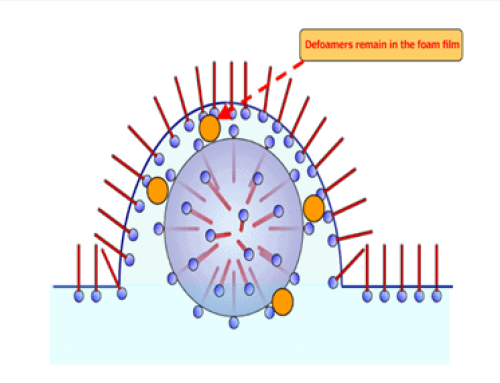
Mechanistically, mineral-oil defoamers commonly combine an oil phase, hydrophobic particles and emulsifying or spreading components. Peer-reviewed work in Langmuir shows that hydrophobic particles, surfactants and small amounts of silicone oil can each affect interfacial transport and defoaming performance. Exact commercial compositions and ratios remain product-specific.
The role of the carrier is to bring the main defoaming substance into the foam system, so that it diffuses on the foam film, and plays the role of bearing and dilution. It has a great influence on the defoaming performance and durability of the defoamer. It is a low surface tension substance, has suitable incompatibility with the foam system, and is easy to rise to the surface of the foam system; the size of the hydrophobic particles is 0.1 Between ~20 μm, it mainly plays an active role in the formulation; emulsifiers or spreaders are used to adjust the compatibility of the active ingredients in the coating system, to balance the compatibility and incompatibility, and to ensure the active ingredients It diffuses quickly and penetrates the surface of the coating film quickly, so that the active ingredients immediately defoam. In addition, mineral oil defoamers also contain a small amount of stabilizers or preservatives.
- Silicone defoamers include polydimethylsiloxane defoamers and modified polydimethylsiloxane defoamers, collectively referred to as silicone defoamers. Among them, the polydimethylsiloxane antifoaming agent is a non-volatile oily liquid, with a degree of polymerization of tens to hundreds, with stable physical and chemical properties and a very low surface tension; modified polydimethylsiloxane Class defoamers have suitable hydrophilic and lipophilic balance values. For example, polydimethylsiloxane defoamer modified with organic fluorine, which is a defoamer with extremely low surface tension and excellent defoaming ability. Although polysiloxane defoamers have low surface tension, strong defoaming and foam suppression capabilities, and do not affect the gloss, improper use will cause film shrinkage and poor recoatability.
- Polyether defoamers are products with suitable incompatibility obtained by selectively modifying some polymers, and are mainly used in some systems that require higher compatibility. For example, there is incompatibility between acrylate and epoxy resin. For this reason, consciously change the polarity, relative molecular weight and distribution of the polymer to make it a proper balance between “miscible” and “immiscible”, so that the obtained defoamer product is compatible with silicone defoamer Compared with other agents, it has better miscibility and does not stabilize foam. This is the characteristic of polyether defoamers, but it often has the problem of weak or no defoaming ability, so its market demand share is small.
A new generation of defoamers and characteristics
The above-mentioned defoamers are all traditional defoamers, and their defoaming substances are all water-insoluble substances, and proper amount of emulsifiers, extenders, etc. need to be added to make them quickly and uniformly dispersed in the water-based paint to exert their defoaming effect. If for some reasons, such as the common construction method of adding water to dilute before painting, the emulsifier will be separated from the surface of the defoaming material, so that the water-insoluble defoaming material will easily cause shrinkage on the surface of the coating film. , This is a common disadvantage of traditional defoamers. In addition, it is very difficult for a high-viscosity coating system to achieve an ideal defoaming effect. This is because the high-viscosity system makes it difficult for the liquid to flow between bubbles, and the film wall of the bubbles has a certain thickness, which makes it difficult to make it Rupture, which will cause a lot of pinholes in the paint film. Therefore, it is necessary to develop new defoamers to solve the problems that traditional defoamers cannot solve.
People get inspiration from the structure of a new type of Gemini surfactant, which is a substance formed by linking two or more monomer surfactants together through a chemical bond. For example, two common surfactants with single-chain single-chain single-head groups are connected together by chemical bonds at the ionic head groups, so that the resulting special structure has certain special properties, especially higher surface activity. And other physical and chemical properties.
The structure diagram of Gemini surfactant is as follows:

The characteristics of this structure are:
- At least 2 hydrophobic chains and 2 hydrophilic groups;
- Hydrophobic chains can be hydrocarbon chains of different chain lengths;
- The hydrophilic group can be anionic, cationic or non-ionic, and the two hydrophilic groups in the same molecule can be different;
- According to the difference of the spacer chain, it can be divided into rigid and flexible structures, and because of the heteroatoms, its hydrophobic and hydrophilic abilities are also different, which can be divided into hydrophobic and hydrophilic;
- Most Gemini surfactants have two identical hydrophobic chains and hydrophilic groups.
Gemini-surfactant and supramolecular design concepts may help formulators tune spreading, self-emulsification and compatibility, but they do not guarantee zero cratering or universal dosage reduction. INVINO-3100 should be evaluated as a candidate enhanced mineral-oil defoamer for acrylic and styrene-acrylic systems. Any comparison with another supplier’s grade, claimed dose reduction, cost saving, storage stability or fine-foam advantage must be supported by a side-by-side test using the same formulation, dosage basis, aging condition and evaluation method.
Recommended validation criteria:
- initial foam knockdown and microfoam release;
- wet-film density and air content;
- craters, pinholes, gloss and recoatability;
- storage stability after temperature aging;
- total cost at the lowest technically acceptable dose.
China’s demand for defoamers and their development trends
Market-data note (reviewed August 13, 2026): The previously published figures—2,000 tonnes of total Chinese defoamer production, 7 million tonnes of 2023 architectural coatings, 4.5% annual growth and 21,000 tonnes of inferred defoamer demand—were based on mixed or unstated scopes and are not retained as current market facts. Multiplying coating output by a single 0.3% dose is not a reliable national-demand method because dosage, solids, product type, process losses and the share of waterborne formulations vary. Use a named dataset with publication date, product scope and methodology before publishing national tonnage or growth estimates.
China’s regulatory environment nevertheless creates a verifiable development driver. GB 30981.1-2025, Limit of harmful substances of coatings—Part 1: Architectural coatings, is current and took effect on June 1, 2026, replacing GB 18582-2020 for its stated scope. GB 37824-2019 separately specifies air-pollutant emission controls for paint, ink and adhesive manufacturing.
In view of the current status and market demand for water-based defoamers in China, research and development in the following areas are needed in the future:
- Develop new high-activity defoamers, such as molecular defoamers and ultra-stable defoamers;
- Develop multifunctional defoamers, such as defoamers with wetting or emulsifying functions;
- Develop powerful defoamers for high-viscosity and high-elasticity coatings;
- Develop compounding technology for defoamers, such as the compounding technology of polyether and silicone; compounding technology of water-soluble or oil-soluble polyether and silicon-containing polyether; compounding technology of organosilicon compounds and surfactants;
- Develop new varieties of modified polyether and silicone defoamers.
Through research and development in these areas, China’s architectural coatings market can be better served with high-performance defoamers.
Meeting China’s Demand with Advanced Defoamers
Through research and development in areas like high-activity, multifunctional, and novel modified defoamers, China’s architectural coatings market can be better served. INVINO is committed to providing high-performance solutions to meet these evolving demands. Learn more about our waterborne defoamer offerings or contact us to discuss your specific needs.