Why Waterborne Coatings & Printing Inks Foam — Causes and Diagnosis
← Back to all Paints & Coatings Applications
Foam is one of the most persistent problems in waterborne coating and ink formulation — and it is rarely solved by simply "adding more product." To fix it you first have to know why the system foams and where in the process the foam is generated. This guide breaks down the root causes, from the surfactants in the can to the substrate, the drying profile and the film build, and shows how to tell surface macro-foam apart from entrained micro-foam — the single most useful diagnosis a formulator can make.
Root Cause 1: The Additives That Wet Your Substrate Also Stabilize Foam
Water has a very high surface tension — about 72 mN/m. On its own it wets substrates poorly and disperses pigment badly. So formulators add surface-active additives — surfactants, substrate wetting agents, pigment dispersants and flow agents — to bring that surface tension down. The catch: the very additives that enable wetting are the ones that stabilize foam. Solving one problem creates the other. Resin binders can also carry foam-stabilizing components of their own.
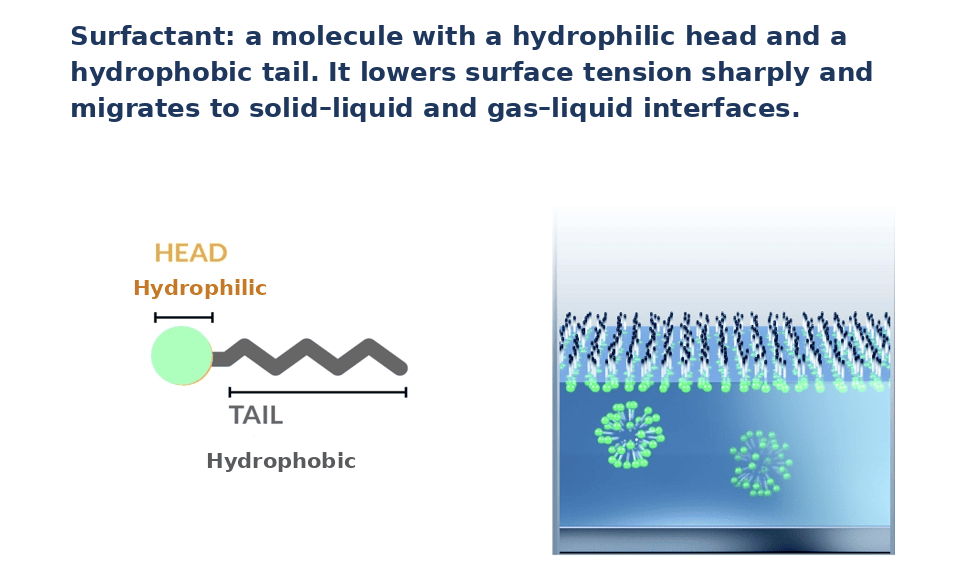
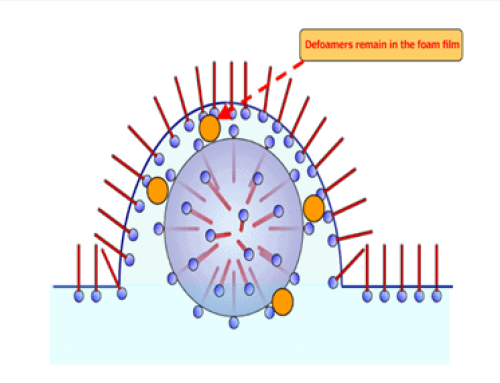
A surfactant has a hydrophilic head and a hydrophobic tail. It migrates to the gas–liquid interface and lowers surface tension — the structure that both enables wetting and stabilizes foam.
Ionic vs non-ionic surfactants make foam differently
How strongly a system foams depends on how completely the surfactant packs the bubble surface (surface coverage, Θcmc) and how elastic the resulting film is (Gibbs elasticity, EG). Ionic surfactants can stabilize a film at much lower coverage because electrostatic repulsion adds elasticity; non-ionic surfactants need higher coverage to reach the same stability. Above a threshold the film becomes stable enough to persist — and that is when foam turns into a production problem.
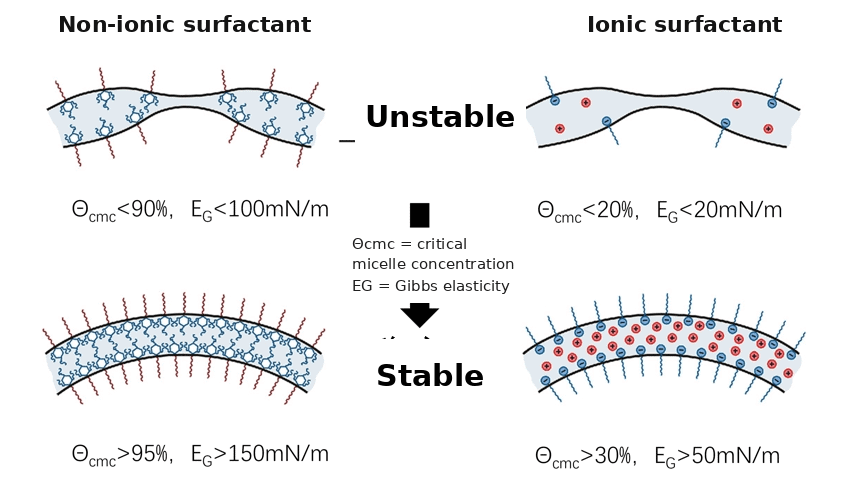
Foam stability rises with surfactant surface coverage (Θcmc) and film elasticity (EG). Ionic surfactants reach a stable film at far lower coverage than non-ionic ones.
Pigment and polymer make foam even more stubborn
Add a small amount of polymer, or fine solids such as pigment or matting powder, and foam stability climbs sharply. Small-molecule polymers interlock with the surfactant film, and nanoparticles bridge it — both raise film elasticity and slow drainage, so foam takes longer to collapse. This is exactly why high-pigment, high-build systems foam the most stubbornly.
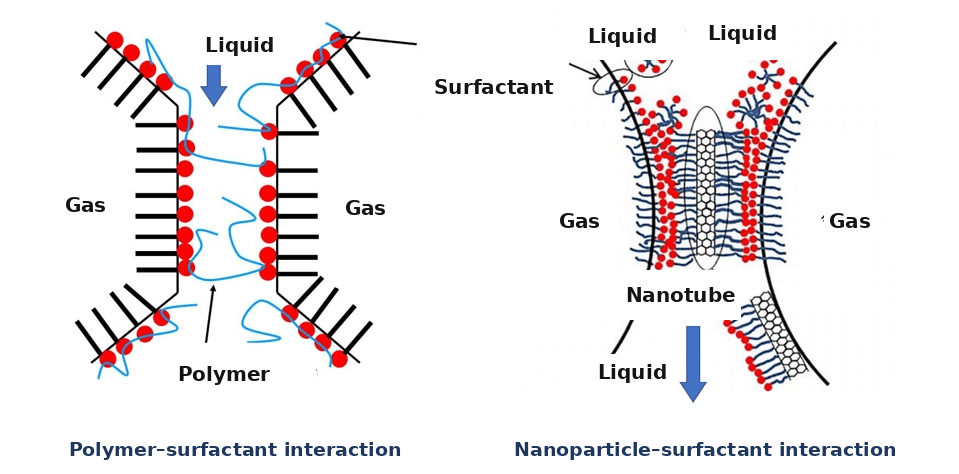
Polymers interlock with the surfactant film and fine particles bridge it — both reinforce the foam film and make it harder to break.
Root Cause 2: Where Foam Is Generated During Application & Drying
Even a well-dispersed coating meets fresh foam challenges as it is applied and dried. Knowing which stage generates your foam is half the diagnosis:
- Substrate wetting: porous, hard-to-wet or contaminated substrates trigger wetting and air-release problems — porous substrates in particular pull air into the wet film.
- Solvent / water evaporation: high temperature or high air flow makes bubbles form and rise faster than they can be removed.
- Reaction foam: 2K systems (such as 2K PU) can generate gas during cure — watch its persistence.
- Surface (open) time: when the surface skins over too fast, or the film is applied too thick, bubbles cannot reach the surface and escape before the film sets.
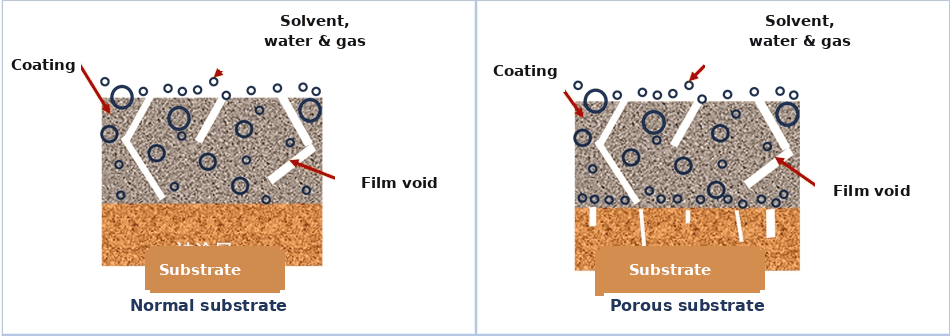
On a porous substrate, air is drawn from the pores into the wet film, seeding micro-foam and film voids that a normal substrate would not produce.
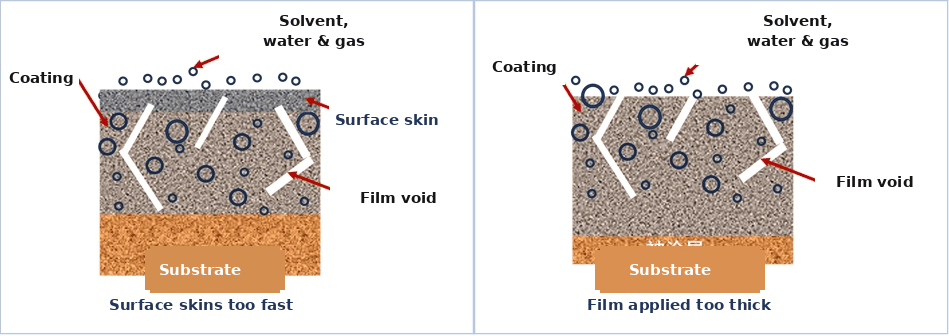
When the surface skins over too fast, or the film is applied too thick, bubbles are trapped before they can escape — leaving voids inside the cured film.
Application method matters too: brush and roller application entrains a lot of air and needs fast air release, while high-viscosity, high-build systems trap fine bubbles that can only be removed slowly. In practice, flash-off time and film thickness directly determine how hard a system is to clear.
Diagnosis: Is It Surface Macro-Foam or Entrained Micro-Foam?
This is the single most useful call a formulator can make, because the two problems look different, show up in different systems, and are solved by different additives. Use the visual below to place your problem.
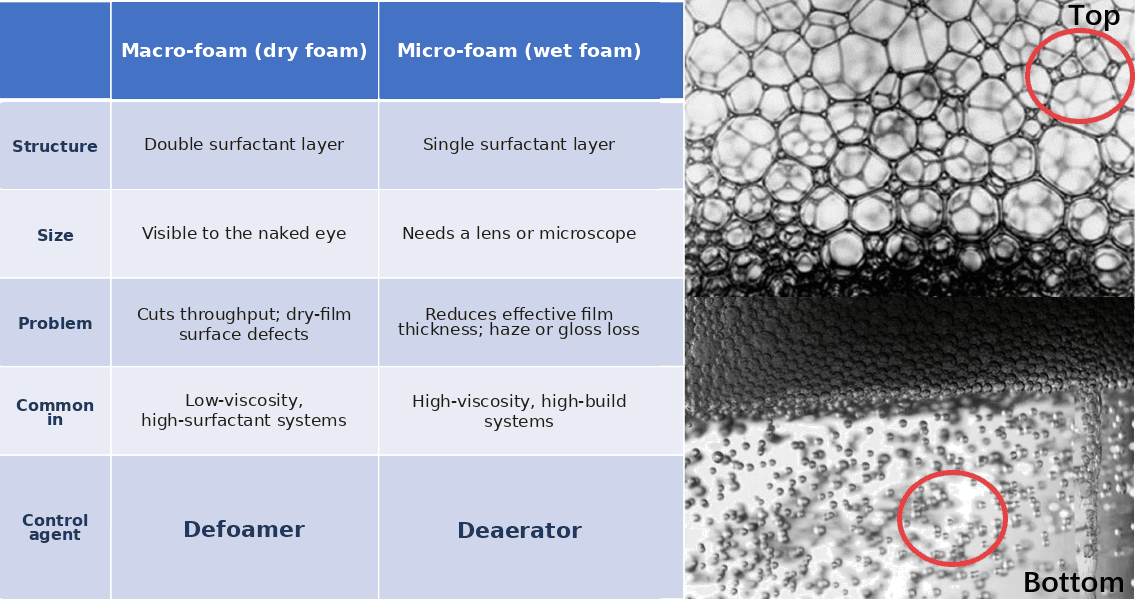
Macro-foam sits at the surface (low-viscosity, high-surfactant systems); micro-foam is entrained in the film (high-viscosity, high-build systems) and shows up as pinholes, haze or gloss loss.
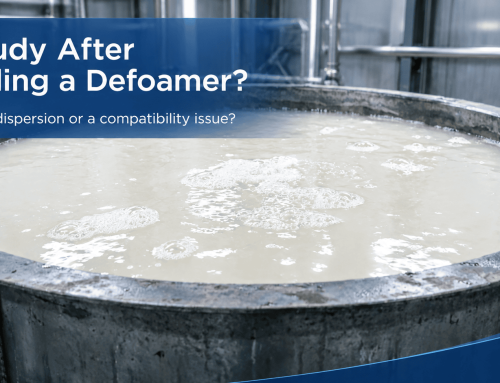
- Surface macro-foam — large, visible bubbles that overflow the tank or leave crater-type surface defects. Most common in low-viscosity, high-surfactant systems.
- Entrained micro-foam — fine air visible only under a lens, showing up as pinholes, haze or gloss loss in the dried film. Most common in high-viscosity, high-build systems.
These two foam types call for two different additive types. For a full breakdown of how the two additives differ and how to choose between them across all industries, see our dedicated guide: what is a defoamer and a deaerator? The underlying rupture mechanism — how a droplet enters, spreads and breaks the bubble film — is covered in our primer on the mechanism of anti-foaming agents.
What Foam Actually Costs Your Coating
Whichever type you have, unmanaged foam damages the coating in specific ways:
| Symptom in the film | What it signals |
|---|---|
| Craters & fish-eyes | Surface macro-foam bursting, or an incompatible additive dewetting the film. |
| Pinholes & voids | Entrained micro-foam locked into the film before it could escape. |
| Haze / gloss loss | Fine bubbles scattering light through the cured film. |
| Reduced film thickness & protection | Air volume replacing solids — thinner effective film, lower corrosion resistance. |
| Slow filling / overflow | Surface foam cutting throughput on the line. |
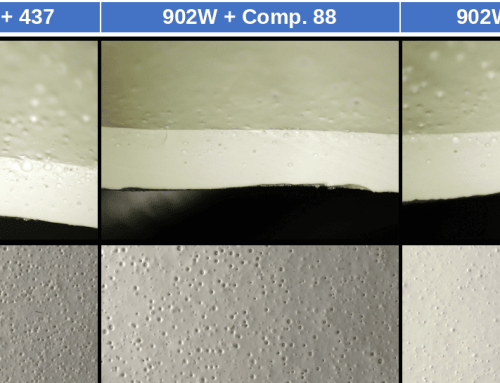
Surface appearance alone can mislead: a film can look perfect and still hold micro-foam voids inside. The reliable check is to cast the film, dry it, and section it — the method shown in our head-to-head coating & ink foam-control results, where dry-film cross-sections reveal what the surface hides.
From cause to cure
Once you have diagnosed the foam, matching the right grade is the next step. Explore the options by chemistry — silicone for fast knockdown, mineral oil or other non-silicone chemistries for silicone-sensitive systems — or send us a sample and let our lab match it for you.
Why a Trial in Your Own System Is Essential
Foam behaviour depends on your exact surfactant package, pigment loading, resin, viscosity and drying profile — which is why the same additive can be flawless in one system and cause craters in another. Diagnosing the cause tells you what to test for: knockdown speed, persistence, compatibility and dry-film cleanliness. For a structured approach, start with our antifoam selection guide and our methods for testing antifoam performance.
Frequently Asked Questions
Q: Why do waterborne coatings and inks foam so easily?
A: Water has a high surface tension (~72 mN/m). To wet substrates and disperse pigment, formulators add surfactants, wetting agents and dispersants that lower it — and those same surface-active additives stabilize the foam films between bubbles. Solving the wetting problem creates the foam problem.
Q: What causes foam during coating application and drying?
A: Porous or hard-to-wet substrates pull air into the wet film; fast solvent or water evaporation makes bubbles rise faster than they clear; 2K systems can generate reaction gas; and when the surface skins over too fast or the film is applied too thick, bubbles are trapped before they can escape.
Q: Why does foam cause craters and pinholes in the dried film?
A: Surface macro-foam that bursts leaves craters; micro-foam trapped inside the film becomes voids and pinholes that reduce effective film thickness, cause haze or gloss loss, and lower corrosion resistance. Fast surface skinning, thick films and porous substrates all trap more air.
Q: How do I tell if I have macro-foam or micro-foam?
A: Macro-foam is the large, visible foam at the surface, common in low-viscosity, high-surfactant systems. Micro-foam is fine, entrained air visible only under a lens, common in high-viscosity, high-build systems, and it shows up as pinholes, haze or gloss loss in the dried film.
Q: Why is high-viscosity or high-build coating harder to clear of foam?
A: In thick, viscous films small bubbles cannot rise to the surface easily, foam migrates slowly, and the film skins over before air escapes. This traps micro-foam inside the film, which is why high-build systems need special attention to air release.
Request a Free Lab Diagnosis & Sample
Send us your system details or your actual foaming liquid. Our China laboratory identifies whether you are fighting surface macro-foam or entrained micro-foam, matches a suitable grade, and returns a free sample with knockdown, persistence and compatibility data for your formulation.