Defoamer for Waterborne Coatings & Printing Inks
← Back to all Paints & Coatings Applications
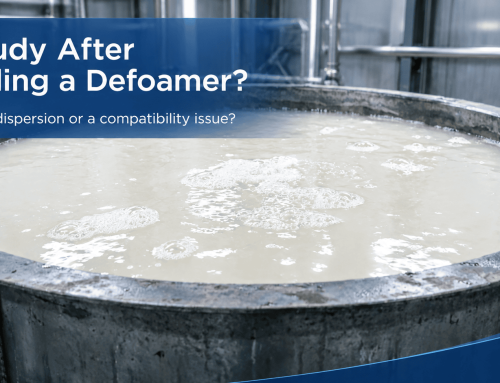
Every coatings and ink formulator knows the compromise. Push the defoamer dosage up and you get craters and fish-eyes. Back it off to protect the film, and micro-foam survives into the dried coating as pinholes and voids that quietly destroy corrosion resistance.
That compromise is a symptom of uncontrolled incompatibility — not a law of chemistry. INVINO supplies defoamers for waterborne coatings and printing inks engineered to break foam fast and stay compatible afterwards. Below is the bench data.
Key Test Results at a Glance
Why Waterborne Systems Foam So Stubbornly
Solvent-borne coatings rarely foam badly. Waterborne systems foam because of the very things that make them work — and each cause demands something different from the defoamer.
| Root Cause | What It Does to the Foam Film |
|---|---|
| High Surfactant Load | Emulsifiers, wetting agents and dispersants are surface-active by design. Every one of them stabilizes the liquid film between bubbles. |
| High Pigment Loading | Fine solid particles adsorb at the air/liquid interface and mechanically resist film drainage — a Pickering-type stabilization. |
| High Shear Processing | Grinding, high-speed dispersion and pumping continuously entrain air into a medium chemically primed to hold it. |
| Fast-Drying, Viscous Films | Entrained air has little time to escape before the film skins over. What is trapped stays trapped — as internal voids. |
How a Polyether-Modified Silicone Defoamer Works
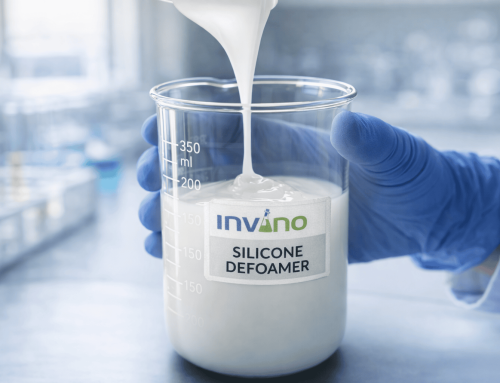
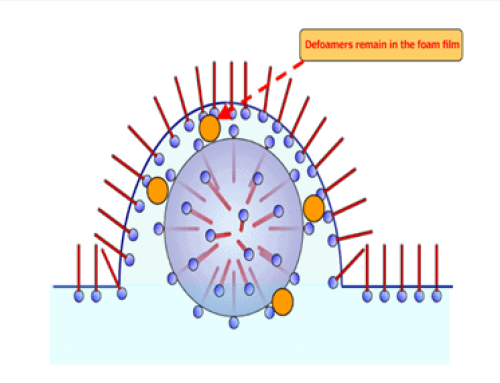
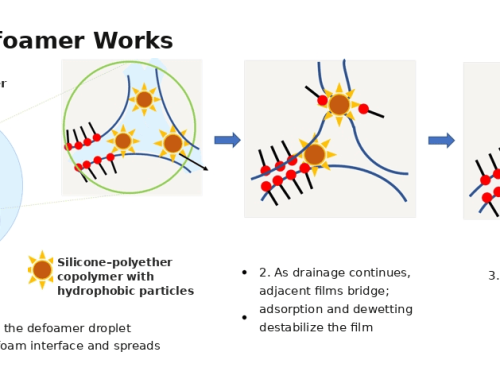
A defoamer must be controllably incompatible: insoluble enough to form droplets that enter the bubble film, yet compatible enough that it never accumulates at the coating surface as a defect. INVINO 437 is a polyether-modified polysiloxane emulsion containing fumed silica. Each component does one job.
| Component | Function in the Foam Film |
|---|---|
| Polysiloxane (PDMS) | Very low surface tension; enters and spreads across the lamella, displacing the stabilizing surfactant. |
| Polyether Modification | Tunes the hydrophilic–lipophilic balance, keeping the droplet finely dispersed instead of coalescing into surface defects. |
| Fumed Silica | Rides the silicone droplet and mechanically bridges the film — the bridging–dewetting rupture that collapses the bubble. |
| Aqueous Carrier | Directly dilutable with water. No organic solvent, low VOC. |
This is the difference between plain silicone oil and an engineered compound. Silicone oil alone lowers surface tension; only the silica-loaded, polyether-modified compound ruptures the film fast and stays compatible afterwards. For the underlying physics see our primer on the defoaming mechanism, or browse the full silicone defoamer range.
Recommended: INVINO 437 — Coatings & Printing Ink Defoamer
Polyether-modified polysiloxane emulsion with fumed silica, 25% active content. Fast knockdown plus persistent suppression in high-surfactant, high-pigment systems; no delamination or floating oil; no loss of film gloss. Water-dilutable and organic-solvent free. Where a formulation cannot tolerate silicone at all, use a mineral oil defoamer or another non-silicone chemistry instead — never a starved silicone dose. INVINO 4371 is the alternative compatibility profile for resin systems that need it.
Laboratory Evidence
The following data was generated in our own R&D laboratory under controlled dosing and dispersion conditions. Every panel compares INVINO 437 against imported and domestic reference defoamers in the same base. The bubbling and shake methods used here are described in standard methods for testing antifoam performance.
Foam collapse in less than half the time, at identical dosage
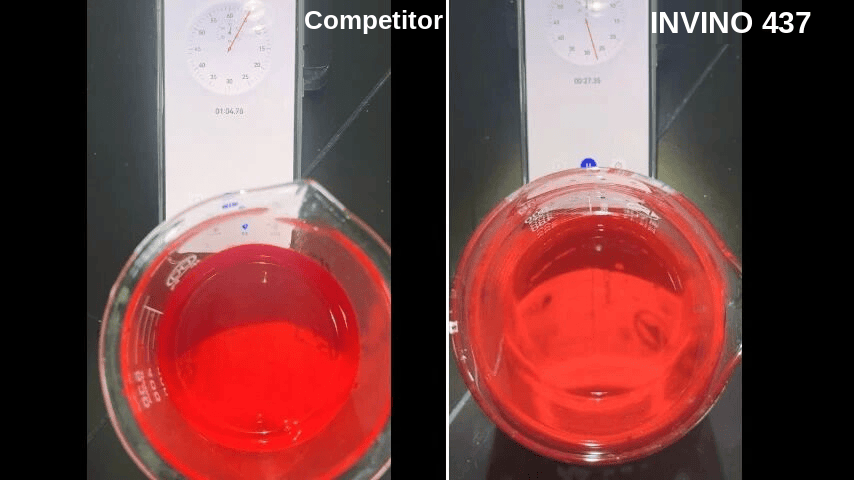
Into a customer-supplied ink base, 0.1% of INVINO 437 and of a competitor defoamer were each added and dispersed at 1500 rpm for 5 minutes. The disperser was stopped and the time to complete foam collapse recorded.
Time to complete foam collapse in a printing ink base at 0.1% dosage: INVINO 437 — 00:27.35; competitor — 01:04.78.
For an ink producer that gap is the difference between unloading a disperser on schedule and idling while entrained air releases.
Suppression held under continuous 200 L/min aeration
Knockdown speed alone is not enough. A defoamer must also suppress foam for the duration of the process. Under continuous aeration at 200 L/min, INVINO 437 held foam height down where four reference products progressively failed.
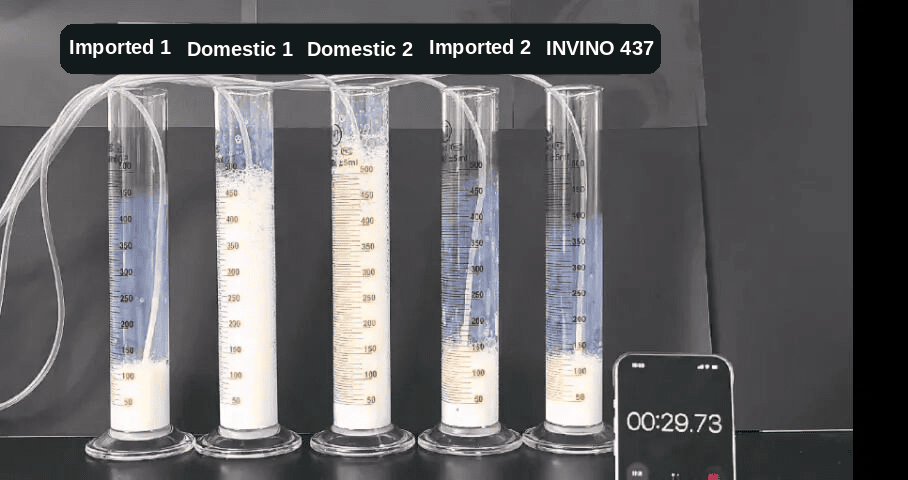
Frame captured after aeration stopped. INVINO 437 (far right) retains the lowest residual foam column.
No delamination, no floating oil at 0.3%
This is where most silicone defoamers fail. At a demanding 0.3% dosage the ink was shaken for one minute and five minutes, then drawn down. INVINO 437 showed no delamination and no floating oil — the compatibility failure that produces surface haze, print skips and uneven film formation.
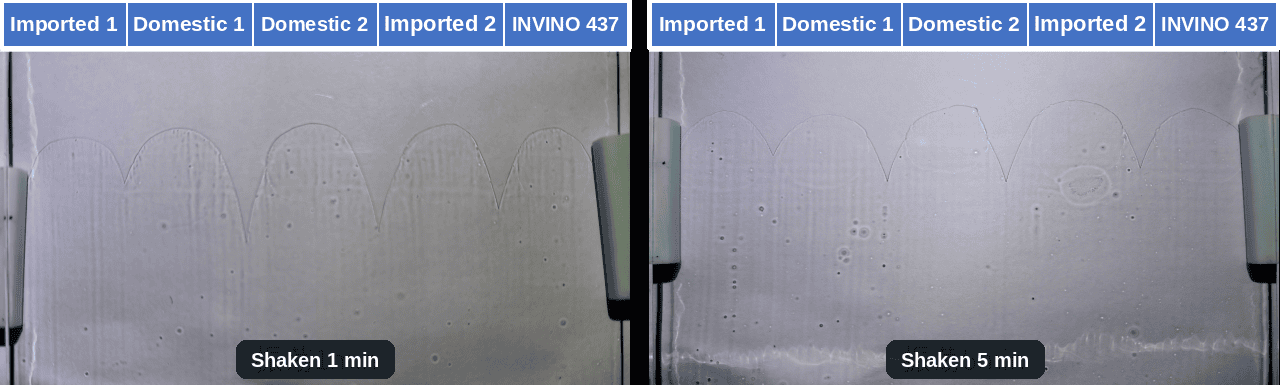
Compatibility after shaking at 0.3% dosage. No delamination, no floating oil — printing flow and film uniformity are preserved.
Engineer's note: "Silicone causes defects" is a myth of mismatched grades, not of silicone chemistry. The polyether modification exists precisely to keep the silicone finely dispersed instead of letting it float out.
Gloss uniformity restored, not sacrificed
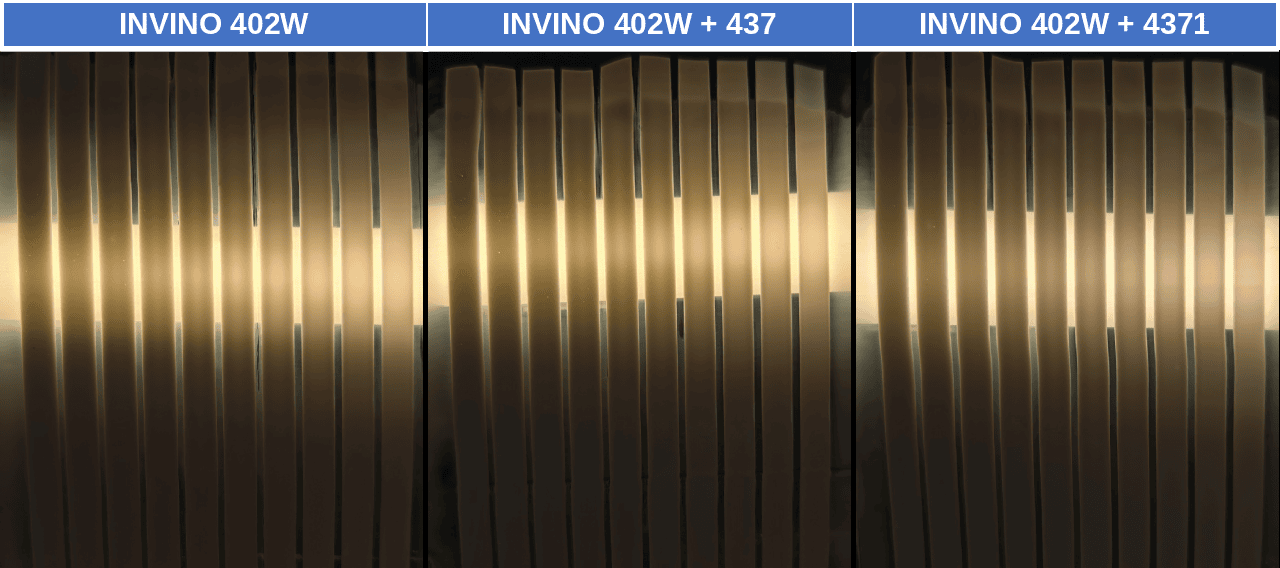
The undosed 402W base shows disrupted reflections. Adding INVINO 437 restores gloss uniformity across the panel.
Large bubbles eliminated at high film build
Thick wet film is the hardest case: a long release path, and macro-bubbles that reach the surface and burst into craters. In a bubble-break film-thickness test, INVINO 437 rapidly eliminated large bubbles in high-build wet film.
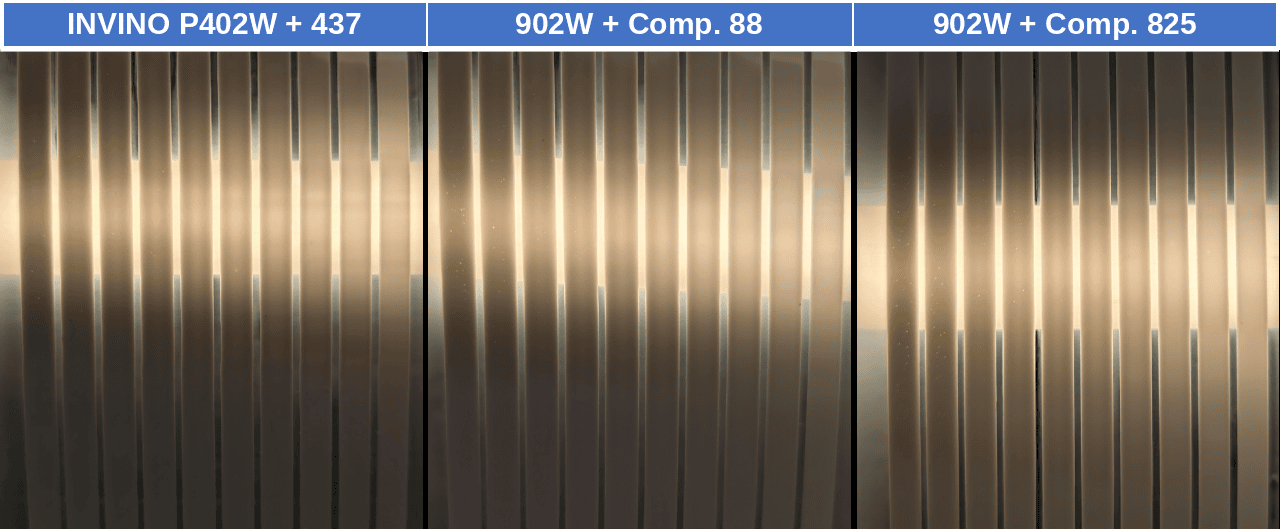
The INVINO P402W + 437 panel shows clean, undistorted reflections. Competitor-dosed panels retain visible surface disturbance.
The test that actually predicts corrosion resistance
Surface appearance can lie. Micro-foam that never reaches the surface still becomes voids inside the cured film — and voids are where corrosion starts. Samples were dispersed at 1200 rpm for 5 minutes, cast, air-dried 48 hours, oven-dried 12 hours, then sectioned for microscopic examination of the film interior.
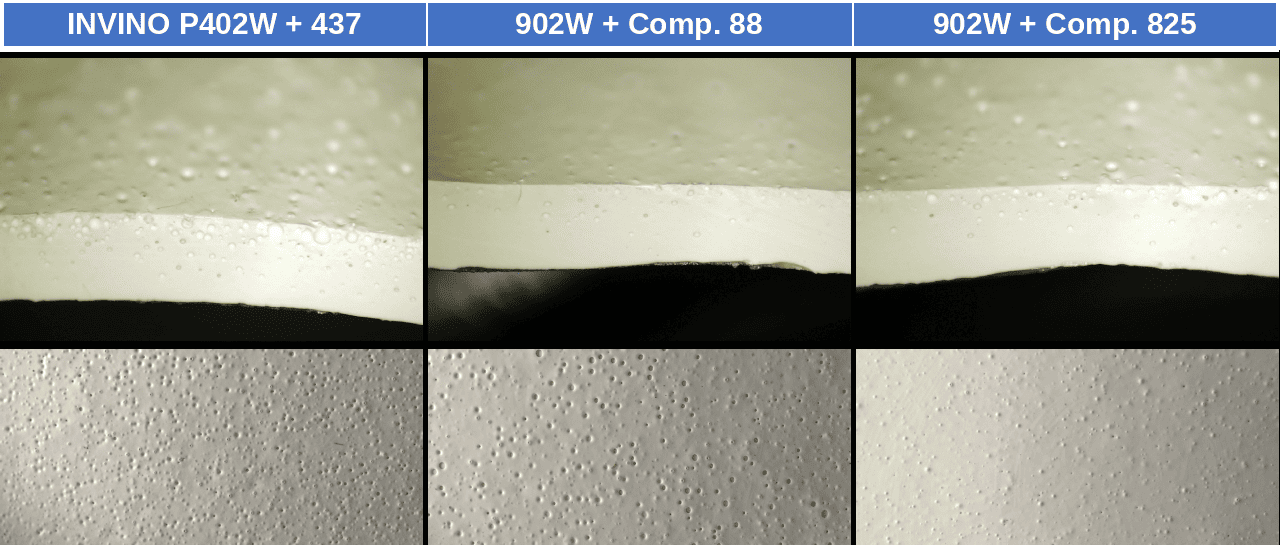
Cross-section and surface of the cured film. With INVINO 437 the film shows a dense internal structure, few micro-bubbles and few surface craters.
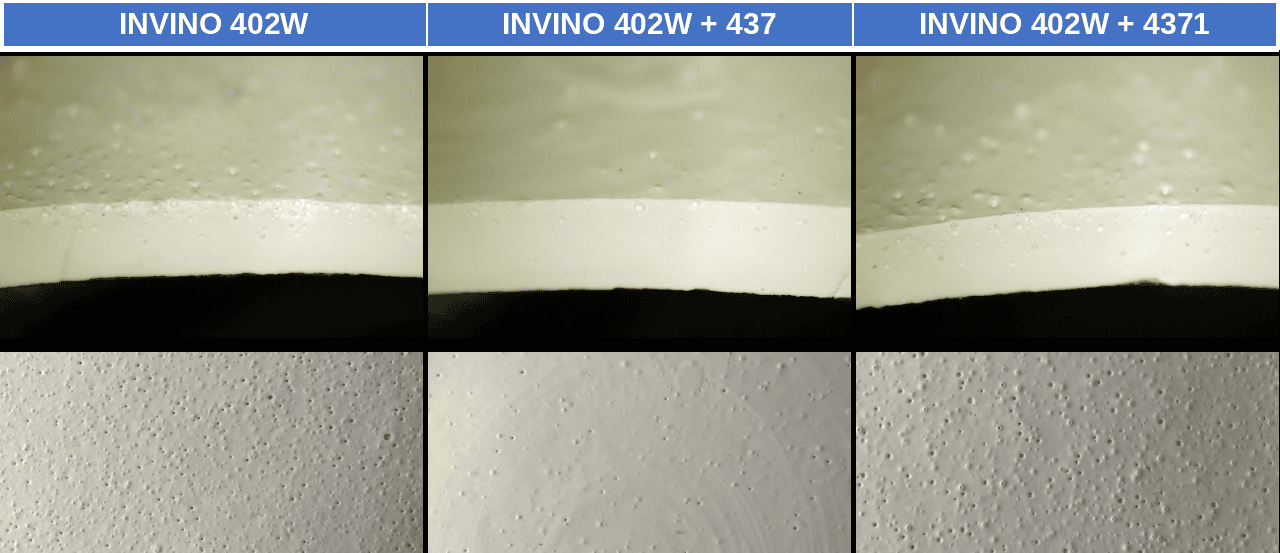
Same system, comparing the undosed base against INVINO 437 and INVINO 4371. The 437 panel carries the lowest entrained bubble count.
A coating can look perfect and still be full of voids. Gloss does not predict corrosion resistance — cross-section does.
Foam control without paying for it in appearance
A two-component matte white topcoat punishes any defoamer that trades appearance for foam control — a matte surface reveals every crater. Five panels were drawn down, including a blank (no defoamer) control.
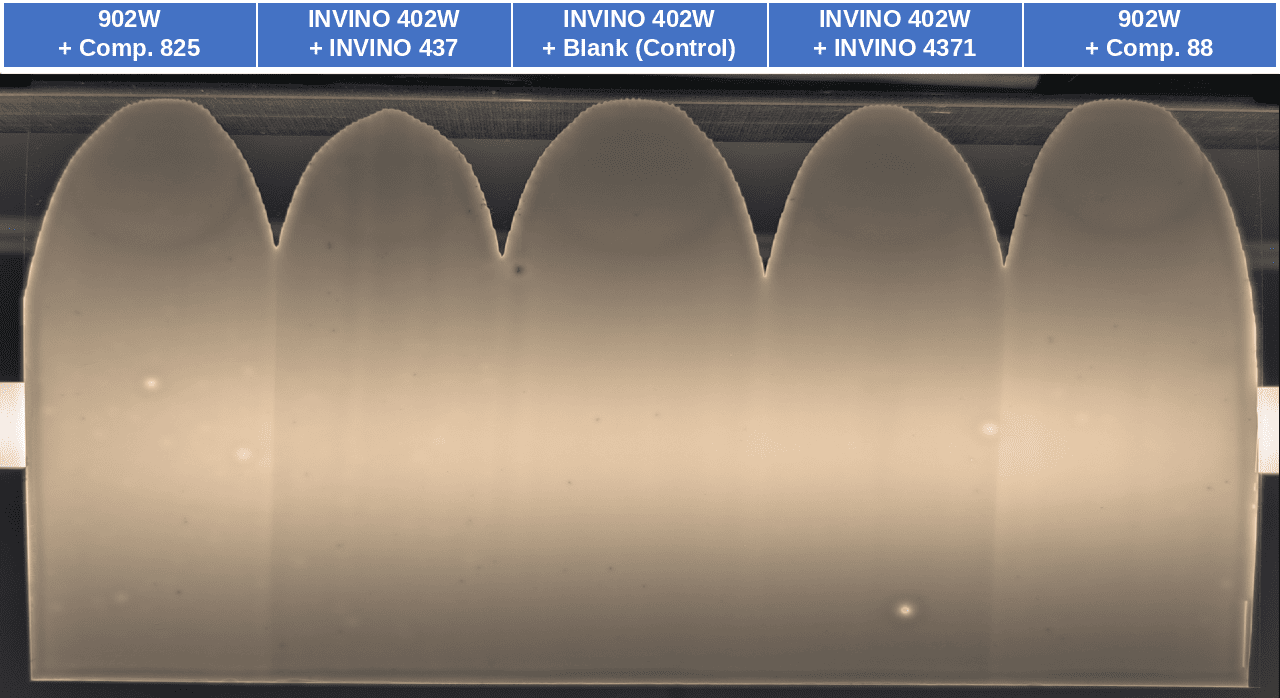
Five-panel wet film drawdown including a blank control. The defoamer-free panel carries the highest entrained air.
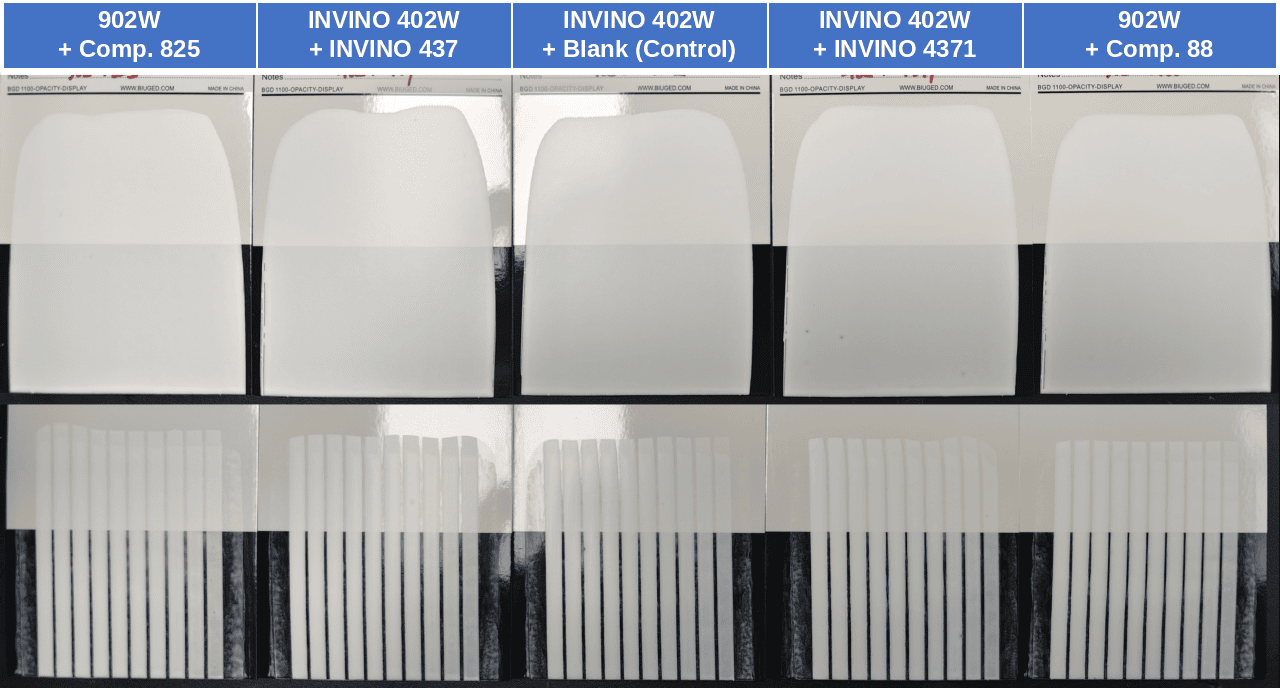
Drawdown on a BGD 1100 opacity chart. INVINO 437 balances foam control against film appearance — good compatibility, high gloss retention.
Technical Data
| Item | INVINO 437 |
|---|---|
| Appearance | Thixotropic milky-white liquid |
| Active Content | 25% |
| Carrier | Water (organic-solvent free) |
| Dosage | 0.1 – 1.0% on total formulation, as supplied |
| Packaging | 30 kg / 200 kg / 1000 kg |
| Storage Stability | Sealed in original packaging, 4 °C – 40 °C, minimum 12 months |
Full TDS and SDS are available from our technical document library. Replacing an incumbent product? Start from the defoamer cross-reference guide.
Recommended Starting Dosages
| System | Starting Dosage | Notes |
|---|---|---|
| Printing Ink | 0.1 – 0.3% | 0.1% already delivers full knockdown in Test 01. |
| Waterborne Epoxy Primer | 0.2 – 0.5% | Move toward the top of the range for high-build application. |
| 2K Waterborne Topcoat | 0.2 – 0.5% | Verify gloss and matte uniformity at target dosage. |
| High-Shear / High-Pigment Mill Base | 0.3 – 1.0% | Consider split dosing across grind and let-down. |
Split dosing usually beats a single high dose. Add part at the grind stage to control process foam, and part at let-down to preserve antifoam persistence in the finished product. If you pre-dilute, follow how to dilute silicone defoamer correctly — incorrect dilution is a common cause of apparent "product failure".
Where INVINO 437 Is Used
- Printing inks — water-based flexo, gravure and screen inks where micro-foam causes print skips
- Industrial coatings — waterborne epoxy primers and high-build protective systems
- Road marking & traffic coatings — fast application, thick film, zero tolerance for craters
- Wood coatings — 1K and 2K systems where gloss retention is non-negotiable
- 2K waterborne topcoats — matte and gloss finishes
Broader formulation context for this sector sits on our defoamers for paints & coatings hub. Neighbouring systems with similar entrained-air problems include adhesives and emulsion polymerisation.
Compliance & Quality
| Item | Status |
|---|---|
| REACH | Screened against the ECHA SVHC Candidate List; a current statement is supplied with each consignment. |
| ISO 9001:2015 | Batch-traceable manufacturing under the ISO 9001 quality framework. |
| Third-Party Testing | Heavy metals, PAHs and phthalate restriction reports available on request. |
| Solvent-Free | Water-carried emulsion, directly dilutable. No organic solvent. |
Scanned certificates: view all INVINO certifications.
Why Bench Testing Is Non-Negotiable
A defoamer is a formulation-specific chemical, not a drop-in commodity. Entering, spreading and dewetting all depend on your exact surfactant package, pigment loading, resin, shear and drying profile. The grade that is defect-free in a waterborne epoxy can misbehave in a 2K matte topcoat. Every number on this page came from a bench test — and none of them substitutes for a bench test in your medium. If you are still narrowing the chemistry family, start with our antifoam selection guide.
Technical Guides for Coating Defect Diagnosis
Use these practical guides to separate foam-control problems from compatibility, viscosity and application defects:
- Eliminating pinholes and micro-foam in high-viscosity coatings — when entrained air remains below an apparently smooth surface.
- Troubleshooting crater defects in water-based coatings — a diagnostic path for defoamer incompatibility, overdosing and surface-tension imbalance.
- Choosing a defoamer for low-viscosity acrylic adhesives — selection guidance for neighboring water-based polymer systems.
Q&A: Foam Control in Coatings & Inks
Q: What is INVINO 437?
A: A polyether-modified polysiloxane emulsion defoamer containing fumed silica, with 25% active content, designed for waterborne coatings and printing inks carrying high surfactant and high pigment loading.
Q: What dosage of defoamer should I use in a waterborne coating?
A: 0.1 – 1.0% on the total formulation as supplied. Printing inks typically need 0.1 – 0.3%; high-build industrial coatings 0.2 – 0.5%. Split dosing across grind and let-down usually outperforms a single high dose.
Q: Will a silicone defoamer cause fish-eyes or craters in my coating?
A: Only if the grade is unsuitable or over-dosed. The polyether modification keeps the silicone finely dispersed instead of floating out. Confirm with a compatibility drawdown at your target dosage before scaling up.
Q: Can INVINO 437 be diluted with water?
A: Yes. It is a water-carried emulsion, directly dilutable, and contains no organic solvent. Dilute with cold water and use promptly.
Q: How should the defoamer be stored?
A: Sealed in the original packaging between 4 °C and 40 °C, INVINO 437 remains stable for a minimum of 12 months.
Q: How do I know a defoamer is not leaving micro-foam inside the dried film?
A: Surface inspection is insufficient. Cast the film, air-dry 48 hours, oven-dry 12 hours, then section it and examine the interior under magnification — the method used to generate the Test 06 data above.
Q: INVINO 437 or INVINO 4371 — which grade should I test?
A: Both perform strongly. In the data above, 437 consistently delivers the lowest entrained bubble count; 4371 offers a different compatibility profile that suits some resin systems better. We supply both as free samples — test them side by side.