How to Select the Right Antifoam Agent for Paint & Coating Formulations?
Direct Answer
Choose an antifoam by matching it to the formulation’s continuous phase, surfactants, resin or binder, solids, pH, electrolytes, temperature and shear—not by chemical family alone. Screen several candidates at equal active dosage in the complete formulation and compare immediate foam knockdown, long-term suppression and entrained-air release. At the same time check viscosity, wetting, gloss or clarity, craters, filtration, adhesion, storage stability and other application-specific properties. The correct choice is the lowest effective dose that controls foam without creating downstream defects.
Last updated: August 2026
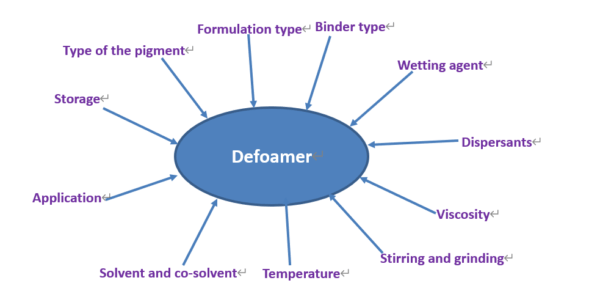
What factors affect the antifoam agent efficiency?
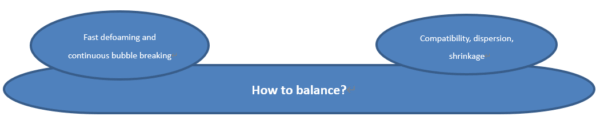
Misconception: Is Stronger Defoaming Always Better?
Not necessarily. Often, higher defoaming power comes at the cost of compatibility. The ‘best’ defoamer is not the strongest one, but the one that achieves the perfect balance between foam suppression and system compatibility (avoiding surface defects like fisheyes).
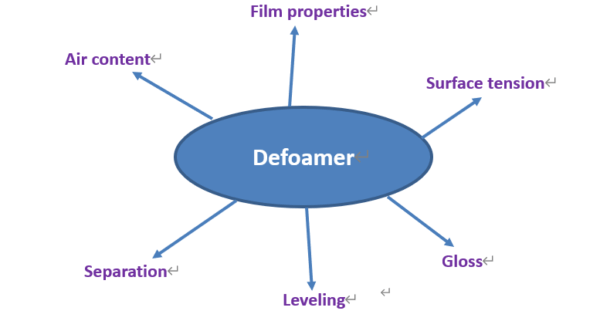
Surface tension
The surface tension of the paint has a greater impact on the defoamer. The surface tension of the defoamer must be lower than the surface tension of the paint, otherwise there will be no defoaming and foam suppression effect. The surface tension of the coating is a variable factor, so when choosing the anti foaming agents, the surface tension must be constant, and then the surface tension variation factor should be taken into account.
The impact of other additives
Most surfactants used in coatings are in a relationship with defoamers that tend to be functionally incompatible. Especially emulsifiers, wetting and dispersing agents, leveling agents, thickeners, etc. will have an effect on the effectiveness of defoamers. Therefore, we must pay attention to the relationship between different additives when choosing various additives, and choose the best balance point.
Baking temperature
When the paint enters high-temperature baking at room temperature, the viscosity starts to drop back instantly, and the bubbles can move to the surface. However, due to the evaporation of the solvent, the solidification of the paint, and the increase in the surface viscosity, the foam will tend to be more stable, trapped on the surface, and shrink. Holes and pinholes, so the baking temperature, fixing speed, and solvent evaporation rate also have an effect on the effectiveness of the defoamer.
The solid content, viscosity and elasticity of the coating
High solids and thick coatings, high viscosity, and high elasticity coatings are very difficult to defoam. In these coatings, the defoamer is difficult to diffuse, the microbubble becomes large, the foaming speed is slow, the foam migration ability to the surface is reduced, and the foam viscoelasticity is large. There are many unfavorable defoaming factors. The foam in these coatings is quite difficult to eliminate. It is best to choose antifoam agent.
Painting method and construction temperature:
There are many coating construction methods, such as brush coating, roller coating, shower coating, blade coating, spray coating, and screen printing coating. Different coating methods have different levels of foaming. Brushing and roller coating have more foam than spraying and scraping. The temperature is higher than that when the temperature is low, but the foam can be eliminated when the temperature is high.
How to choose antifoam agent for paint and coating?
There are many types of anti foaming agents and different characteristics, so the defoamers selected in different formulas are also different:
Quick Selection Guide: Matching Defoamer to Formulation
| Formulation System | Key Challenge | Recommended INVINO® Grade |
|---|---|---|
|
Architectural Paints (Acrylic, Vinyl Acrylic) |
Fast Knockdown & Smooth Finish |
INVINO-3000 / 3100
(Mineral Oil Based) |
|
Waterborne Inks (Flexo, PVC-based inks) |
Long-lasting Suppression |
INVINO-3001
(Mineral Oil) |
|
Waterproof Coatings (High-shear conditions) |
Stability under shear |
INVINO-5023
(Modified Silicone Emulsion) |
| Latex-based Adhesives | Micro-foam control |
INVINO-3200
(Mineral Oil) |
|
Industrial Coatings (High Performance) |
Superior Suppression |
INVINO-604
(Concentrated Silicone) |
*Note: Defoamer selection depends on specific resin systems. Contact our lab for a free compatibility test.
After learn how to choose the antifoaming agent, we also prepared the precautions required for the use of the antifoaming agent:
- Before use, it must be fully stirred and mixed evenly;
- Add with mixing of paint;
- Before use, generally do not add water to dilute;
- Dosage should be appropriate. Excessive dosage will cause problems such as shrinkage, edge shrinkage, and poor brushability; too little dosage will result in poor defoaming effect;
- Is best added in two. That is, they are added separately in the grinding stage and the paint adjustment stage, and each time is generally half of the total amount. A defoamer with good foam suppression effect is used in the grinding stage, and a good foam breaking effect is used in the paint adjustment stage.
Still struggling with formulation compatibility?
Theory is good, but testing is better. Send us your base formulation specs (pH, Viscosity, Resin type), and our lab will recommend the exact grade to balance your surface tension perfectly.