Fiber Cement Board Defoamer: Tackling Foaming Issues in Building Materials Production
For a complete overview of our defoamer solutions for construction materials, visit our main Construction Industry page.
What Is Fiber Cement Board?
Fiber cement board is a high-performance, non-combustible building panel of Portland cement, cellulose fiber, silica, and mineral fillers. Its fire resistance, moisture resistance, structural stability, and ease of processing make it a preferred solution for modern sustainable architecture.

Application Scenarios & Market Demand
Fiber cement board is widely used in exterior cladding and rainscreen facades, internal partitions and ceilings, fire-rated door cores and subfloor panels, and infrastructure lining (tunnels, subways, underground walls). Its versatility and environmental compliance make it ideal for green building certifications like LEED and BREEAM.
Foaming Problems in Fiber Cement Board Production
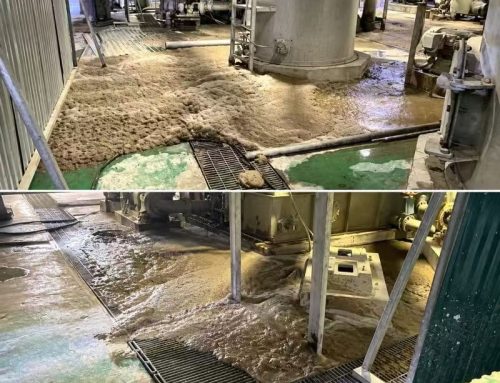
Foaming during the wet-process production of fiber cement boards causes:
- Surface defects: wrinkling, blistering, and rough textures;
- Trapped air leading to delamination or internal voids;
- Uneven curing and reduced mechanical strength;
- Increased product rejection and downtime.
Root Causes of Foaming
- Foaming tendency of cellulose fibers: plant-based fibers like pulp have inherent surface activity.
- Additives promoting foam: dispersants and water-retaining agents often enhance foaming.
- Mechanical air entrainment: high-speed mixers introduce air into the slurry.
- Cement hydration: hydration releases gas, forming microbubbles in alkaline media.
Key Selection Criteria for Fiber Cement Board Defoamer
A high-performance building material defoamer should satisfy the following:
- Strong alkali resistance: compatible with slurry pH values of 11-13.
- Long-lasting suppression: effective from pulping to curing over extended production cycles (antifoam persistence).
- Excellent dispersibility: quick integration with the slurry to prevent oiling or floating.
- Environmental compliance: VOC-free, APEO-free, paraffin-free to meet global sustainability standards.
- Compatibility with cement chemistry: should not retard hydration or compromise setting strength.
Comparing Defoamer Systems for Cementitious Materials
| Defoamer Type | Features | Recommended Use Cases |
|---|---|---|
| Non-silicone polyether | Fast initial defoaming, economical, short-term effect, may cause oiling | Small plants, short-cycle operations |
| Polyether ester (INVINO-8082) | Balanced defoaming/suppression, good dispersibility, cost-effective | Standard board production |
| Polyether-modified silicone | Long-lasting, high alkali resistance, low floating oil, higher cost | High-end thin boards, export-grade materials |
| VOC-free water-based emulsion | Environmentally safe, no paraffin oil, suitable for interior boards | Green-certified products, residential panels |
Recommended: INVINO-8082 — Polyether Ester Fiber Cement Board Defoamer
- Strong alkali resistance: stable at slurry pH 11-13.
- Long-lasting suppression: effective from pulping to curing across long cycles.
- Excellent dispersibility: integrates fast, no oiling or floating scum.
- Environmental compliance: VOC-free, APEO-free, paraffin-free.
- Cement-friendly: does not retard hydration or reduce setting strength.
Best Practices for Defoamer Application
| Parameter | Guideline |
|---|---|
| When to Add | During fiber pulping (prevents initial foam) and slurry mixing (acts on entrained air) |
| Suggested Dosage | 0.1-0.3% of total slurry weight (by viscosity and filler content) |
| Product Form | Emulsion-type (stable, automatic dosing) or dispersion-type (manual, smaller systems) |
| Mixing | Thorough dispersion is key; pre-dilute in high-viscosity slurries; avoid adding too late or at elevated temperatures |
Real-World Case Study
A leading manufacturer in Southeast Asia encountered severe surface blistering and board strength failure due to persistent foam. After switching to an INVINO polyether-based defoamer system:
- Product density improved by 9.5%;
- Flexural strength increased by 12%;
- Waste reduction of over 30%;
- Compliance achieved with EU VOC standards for indoor materials.
Q&A: Optimizing Fiber Cement Production
Q: How does the defoamer improve board strength?
A: By eliminating trapped air and internal voids, INVINO-8082 produces a denser board with fewer weak points, improving flexural strength and density.
Q: Can it prevent surface defects like pinholes or "pockmarks"?
A: Yes. It controls entrained air and surface bubbles during forming, preventing wrinkling, blistering, pinholes and pockmarks.
Q: Will the defoamer clog the felts or sieves in the Hatschek machine?
A: No. It is low-residue and disperses cleanly, so at correct dosage it does not clog Hatschek felts or sieves.
Q: Is it compatible with the high-temperature autoclave process?
A: Yes. It is stable through wet-process and curing and is compatible with autoclaved fiber cement board production.
Q: Does it interfere with retention aids (flocculants)?
A: No. At recommended dosage it controls foam without interfering with retention aids or flocculants.