Project Description
Adhesive Antifoams for Industrial Applications | Foam Control Agent
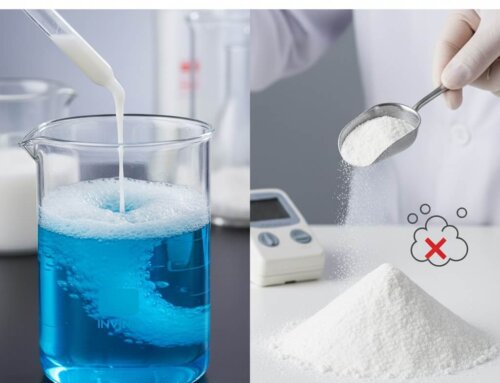
Foam formation during water-based adhesive compounding and subsequent high-speed coating lines lowers dynamic liquid processing densities, impairs film thickness uniformity, and reduces final adhesive bonding strength boundaries. High mechanical shear inputs during chemical blending, combined with aggressive stabilization from structural anionic surfactants, entrain severe macro-air pockets. Mitigating this air build-up without prompting interfacial separation boundaries is an empirical requirement.
INVINO® formulates technical non-silicone polyethers and modified siloxane compounds calibrated to suppress surface macro-froth and internal micro-bubbles within high-solids emulsions. These active agents maintain optimal matrix compatibility, preventing the generation of coating fish eyes, pinholes, or cratering defects across diverse pressure-sensitive adhesives and resin polymer structures.
Get Technical Guidance
Applications of Adhesive Antifoams
Formulated for high-volume compounding loops across packaging adhesive lines, label manufacturing matrices, and paper coating chemical applications. Delivers high compatibility limits, reducing dynamic micro-bubble accumulation without undermining final structural bond lines.
Engineered for precision processing across commercial shipping labels, protective tapes, and specialized technical bonding agents. Accelerates degassing under aggressive mechanical roller pressures, avoiding the formation of localized film fish eyes or structural pinholes.
Calibrated stable throughout base polymer synthesis loops, industrial architectural paints, and heavy-duty protective compounds. Maintains complete structural persistence inside tank storage, preventing phase separation layers or droplet agglomeration boundaries.
Adhesive Antifoams Provided by INVINO®
| PRODUCT CODE | INGREDIENT TYPE | ACTIVE SOLID (%) | TARGET FORMULATION FIELDS | TECHNICAL FILES |
|---|---|---|---|---|
| INVINO-G10 | Silicone-Free Block Polyether Compound | 100.0 | Water-based pressure-sensitive adhesives, high-speed automated label application lines, and zero-silicone systems. | DOWNLOAD TDS |
| INVINO-G202 | High-Compatibility Organo-Modified Siloxane | 30.0±2.0 | General water-based packaging glues, resin compound emulsions, architectural adhesive formulations, and wood glues. | DOWNLOAD TDS |
Choose INVINO® for Reliable Adhesive Antifoams
Q: Will the defoamer weaken the bonding strength of the adhesive?
A: No. Uncalibrated or heavy dosages of raw silicone oils form floating boundaries that warp polymer wetting, directly lowering peel strength. Our compounds undergo strict shear-emulsification controls, dispersing uniformly to protect cohesive and adhesive anchoring strengths.
Q: Can it prevent "Fish Eyes" or pinholes during coating?
A: Yes. Fish eyes are caused by localized surface tension incompatibility boundaries (oil clots). INVINO-G10 utilizes specialized polyether backbones tailored for high surface compatibility, collapsing macro-voids while guaranteeing a completely smooth, continuous coating layout.
Q: Is it safe for food packaging adhesive applications?
A: Our structural formulations utilize chemically inert block copolymers and non-toxic components designed safe from migratory contamination. They maintain robust stability boundaries, making them ideal for the secondary sealing stages of dry food container packaging.
Q: Which types of adhesives is it suitable for?
A: Our range maps across water-based systems, including polyacrylic ester pressure-sensitive emulsions, ethylene-vinyl acetate (EVA) polymer dispersions, polyvinyl alcohol (PVA) matrices, and diverse styrene-butadiene resin compounds.
Q: Can it withstand high-speed mixing or coating speeds?
A: Yes. High-velocity roller and slot-die coating lines apply sharp structural mechanical shear that breaks unstable antifoams. INVINO-G202 features highly modified organosilicon structures that stay physically intact and dynamically persistent under continuous shear lines.
Q: Will adding defoamer change the viscosity of my glue?
A: At standard industrial dosing guidelines (typically 0.1% to 0.3% weights), our non-ionic polymers exert zero structural thickening or thinning effects on the base emulsion rheology, preserving your target flow rates.
Standard Protocol for Adhesive Sample Verification via Empirical Laboratory Metrics
System Parameter Submission
Provide technical data tracking your base resin emulsion (Acrylic, EVA, SBR), compounding viscosity ranges, processing shear speeds, and regulatory regulatory targets.
Laboratory Evaluation via Dynamic Loop Coating & Peel Strength Retention
Our adhesive additives laboratory executes dynamic loop coating simulation trials and strict post-curing peel strength retention tests to isolate a crater-free option.
Physical Sample Freight Dispatch
Validated laboratory trial samples are securely packed and dispatched via express express lines to facilitate direct mechanical rolling tank evaluation metrics.