Project Description
Water-Based Defoamers for Emulsion Polymerization — Foam Control for PVC, EVA, Acrylic & Styrene Systems
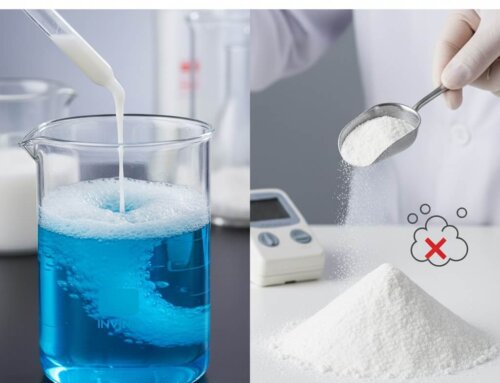
Foam during emulsion polymerization hurts latex stability, blocks uniform particle dispersion, and lowers monomer conversion. Degassing during monomer stripping, batch distillation, and fast transfers pulls air into surfactant-heavy polymer solutions. The challenge is controlling foam without breaking the emulsion or causing phase separation.
INVINO® makes non-silicone polyethers and modified silicone emulsions that dissolve cleanly into reactive latex. They offer high heat and shear stability, knocking down surfactant foam in monomer recovery towers without causing craters, pinholes, or fish eyes in the finished film.
Request a Free Sample
Applications of Water-Based Defoamers in Emulsion Polymerization
Foam in PVC monomer stripping and gas recovery hurts particle dispersion, causing poor porosity and lower conversion.
EVA (ethylene-vinyl acetate) systems foam badly on pressure drops, which spoils batch uniformity.
Surfactants in acrylic coatings foam under fast mixing, hurting dry film thickness and leveling.
Foam during styrene-butadiene rubber (SBR) synthesis disrupts particle size distribution and lowers output.
Selecting the Right Defoamer for Emulsion Polymerization
| PRODUCT CODE | INGREDIENT TYPE | ACTIVE SOLID (%) | Application / Best For | TECHNICAL FILES |
|---|---|---|---|---|
| INVINO-G10 | Non-Silicone Block Polyether | 100.0 | Acrylic emulsion polymerization, silicone-free reactive fluid streams, and monomer flash stripping columns. | DOWNLOAD TDS |
| INVINO-G202 | Silicone Emulsion (Modified) | 30.0±2.0 | PVC suspension polymerization, EVA copolymer tanks, water-based resin compounding, and styrene latex. | DOWNLOAD TDS |
Technical FAQ for Emulsion Polymerization Operators
Q: Will the defoamer cause "Fish Eyes" or craters in the final film?
A: Craters form when incompatible hydrophobic droplets separate from the latex. INVINO-G10 uses high-compatibility polyethers that release bubbles fully while avoiding micro-void defects during drawdown.
Q: Does it interfere with the chemical reaction or catalyst?
A: No. The non-ionic block defoamers are inert to free-radical initiators, redox systems, and standard emulsion stabilizers, so they have no impact on polymerization kinetics.
Q: Do you have a specific solution for PVC resin production?
A: Yes. For high-viscosity PVC suspension processes and monomer stripping columns, the modified silicone emulsion INVINO-G202 offers high heat stability and prevents foam outgassing overflow.
Q: Will it affect the filtration speed of the slurry?
A: No. Poorly dispersed antifoam carriers can blind screen meshes and slow coagulation filtration. INVINO® actives stay well below latex screen sizes, keeping flux steady.
Q: Are your products safe for packaging adhesives and resin coatings?
A: Yes. The grades use stable, inert hydrocarbons and polyether blocks with low migration, suitable for secondary film lamination layers. Please confirm the specific grade against your local food-contact regulation where relevant.
Q: Should it be added before or after the reaction?
A: It depends on your process. A base dose can be metered in with the initial water-phase charge to stop reactor seed foam, with the rest added continuously during the monomer stripping stage.
Request Your Emulsion Polymerization Defoamer Solution
Standard Protocol for Latex Sample Verification
System Parameter Submission
Share your base polymer (acrylic, PVC, EVA, SBR), reaction temperature, line shear, and downstream filter mesh size.
Free Lab Test (Monomer Stripping Shear + Coagulation Check)
Our lab runs a simulated monomer-stripping shear stability test and a coagulation filter-mesh check to find a crater-free match — free of charge.
Free Sample Dispatch
Free trial samples ship via air express for reactor and stripping-tower trials. No MOQ at sample stage; buyer covers freight, refunded on the first bulk order.